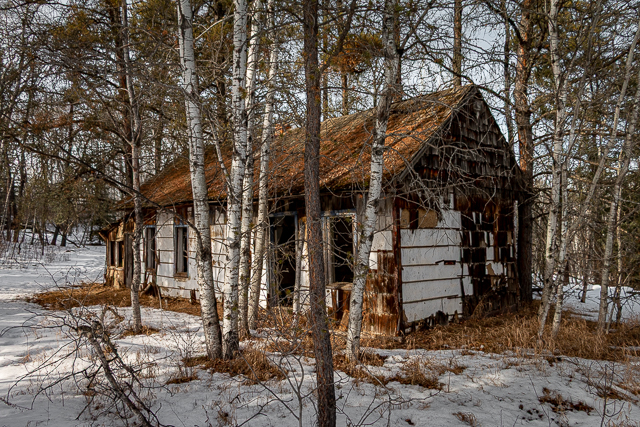
Today we’re looking at remains of the Hermitage of Saint Elias, a former Monastery connected to the Eastern Orthodox Church. The location is a wooded grove and it’s all hidden away along a lonely Northern Alberta back road. This cluster of small cobbled-together buildings are in varying states of advanced decay and likely won’t be around for many more years.
Accompanied by friend and fellow adventurer Robert Pohl, we take time to explore this most fascinating site on his suggestion. It’s a place of incredible sacrifice and one can’t help admire the steadfast dedication of the folks who called it home. Wandering about, we’re taken aback by the primitive conditions and overwhelming isolation of the site.
Hermitage of Saint Elias: a Monastery abandoned long ago. Exploring is an obsession with Chris Doering & Connie Biggart (BIGDoer/Synd)
Thanks to “Anonymous” for sponsoring this and many other posts at BIGDoer.com. Be an angel too…
This is an old article from about a decade ago and we’ve brought it back for your enjoyment, but with a little reworking. The original photos received new edits and while we thought of reshooting the piece, the site has deteriorated badly since our first visit. They just wouldn’t work as well, so the 2016 images stayed. We also rewrote the copy for improved flow and clarity. Now let’s go…
(2016) Welcome to Saint Elias, an abandoned Monastery in N Alberta.
The monastery was founded in the early 1950s as the Hermitage (or Skete) of Saint (or Prophet) Elias. The handful of Monks residing here (5-8 is suggested) were of Ukrainian background and tied to the Russo-Greek Orthodox Church. It’s an arm of Christianity common to Eastern Europe and much of the former Soviet Union.
Scroll down for more photos and to comment.
Many settlers in this section of Alberta, NE of Edmonton, immigrated from Ukraine and Eastern Orthodox Churches, with their distinctive “onion” domes are common to the area.
The Monks survived by farming a section of land, rather low lying and almost swamp-like in nature, at the north end of the property. It was hard going, but a Monk’s lifestyle by design is never easy. They toiled in fields that others would have deemed unsuitable for cultivation and worthless.
As time passed the population of the Monastery dwindled, with the last member leaving in the early 1960s. Perhaps conditions were too tough for even the most resilient of the group. Abandoned for well over sixty years and now forgotten, it’s slowly disappearing. All these buildings made by man are returning to nature and soon they’ll only live on in photos. Like what we’re presenting here.
In the more recent times, a new incarnation of the same order formed and today, members of Saint Elias lead lifestyles much less detached from the outside world than before. Now they live in established communities, drive cars and even use social media. None the less, strict disciplines are still the rule and they focus all their energies on their beliefs.
They don’t eschew mainstream society, but keep near its fringes. The stereotype of the hooded monk, stoic and lost in quiet contemplation, they are not.
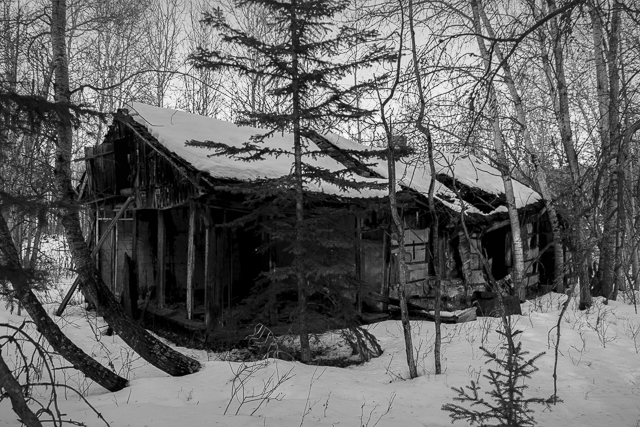
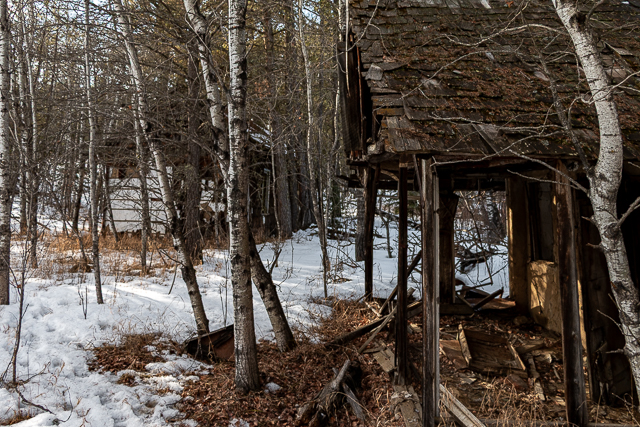
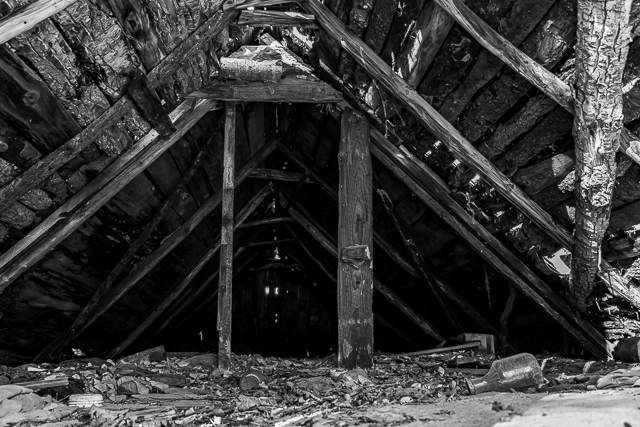
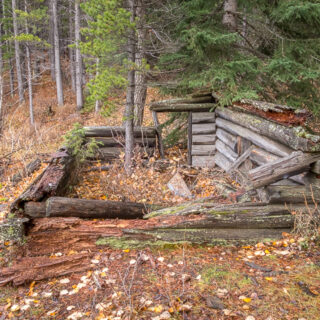
The Monastery site includes perhaps a half dozen structures, all small and simple in construction. Some were living quarters and another functioned as a communal kitchen. One building appears to be chicken coop. Another would have served as a chapel of sorts, devoted to prayer and mediation.
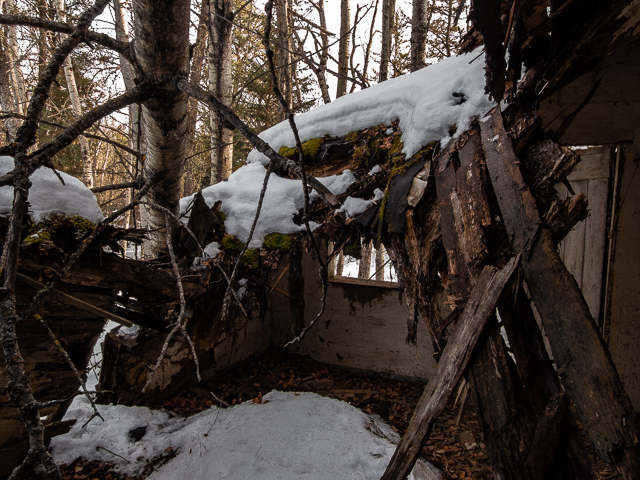
Reflecting the vow-of-poverty nature of the Monastic lifestyle, they built these structurers using what ever they found or scrounged up. Walls are of salvaged lumber or logs and branches. Interiors are mud and straw, with a thick coating of white-washed plaster. That’s a common way to do in the old country, by the way. It’s crude, but functional and effective.
Doors and windows appear salvaged too, the former being cut or trimmed to fit the often odd-shaped opening to which it was placed.
The buildings at Saint Elias are very Dr Suess like, with walls at odd angles to each other. Nothing is square or even remotely level. That’s not necessarily because of settling or collapse, but that they built them this way. We’re not sure that mattered much to those who lived here. A simple life means simple things…plain and, well, simple.
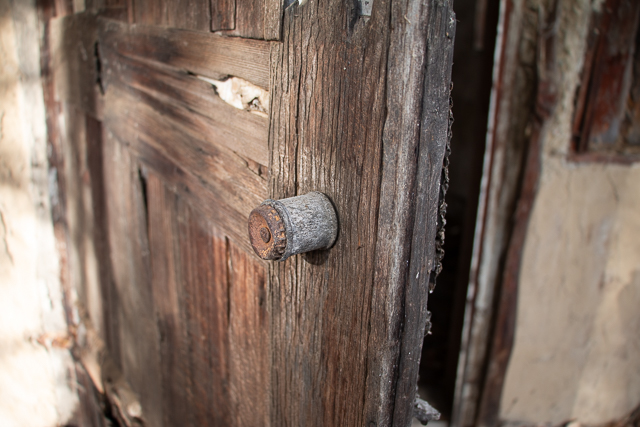
An old wood thread-spool, metal bottle cap and nail make an ersatz door knob. Other building materials include cardboard, newspapers, shingles, the odd brick, fence posts, chicken wire, old wood boxes, moss (for insulation?), various metal strips and angle iron taken from (presumably) old machinery. In other words, they used what ever they could find. When you lack resources, you adapt and make due.
Buildings were heated by wood or perhaps coal, and lit by lantern. No electricity, no connections at all to the outside world, no modern anything and a just a few men vs the wilderness.
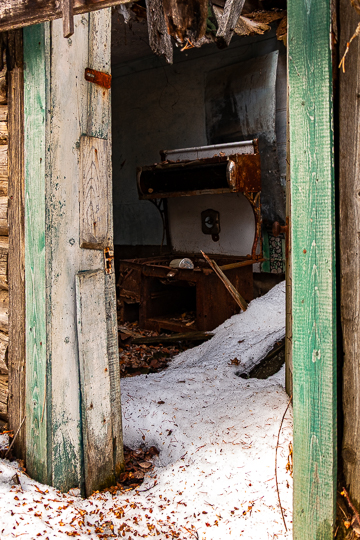
Outside some stoves, a couple crude tables and miscellaneous bits and pieces, the buildings are for the most part empty.
Given the how they were constructed and their use of mostly organic material, the structures have not fared well over time. Some have partially collapsed, while others are close to doing the same. Saplings have grown up all around the site and in couple years we doubt there will be much anything left but the trees.
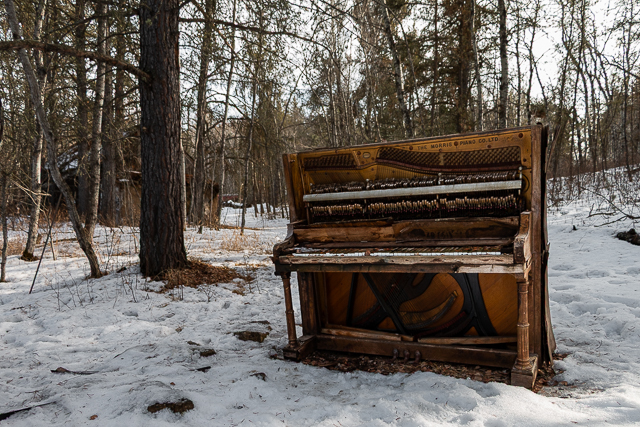
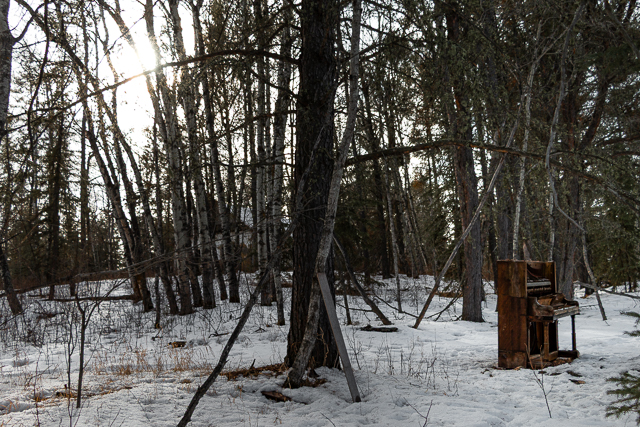
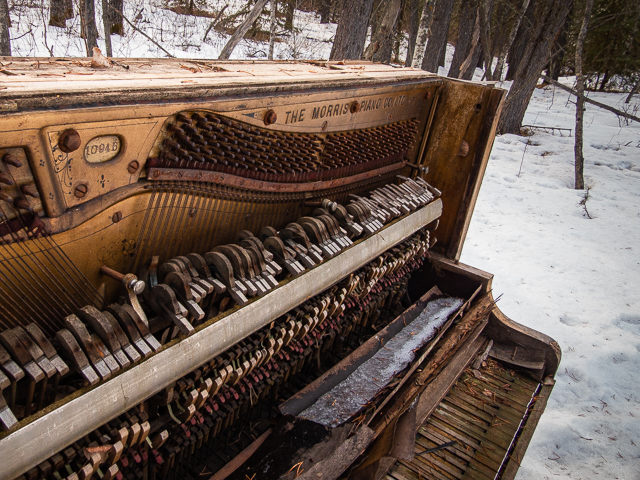
n The piano is not original to the site, but perhaps a strange offering of sorts, from someone. A prank leading to some weird legend? We’ve heard many stories and from a number of folks taking credit for the deed (for one, a photo club), but still no one is quite sure. It’s from maker Morris Piano Company of Ontario and is clearly quite old.
The serial number suggests, based on the limited data we could find, that it dates back to the first decade of the twentieth century. It’s not a fancy piano and appears to be a budget model of the era.
Exposed to the elements as it is, it’s in pretty rough shape. It was likely not much better when placed here and probably destined for the junk pile anyway. It may have arrived a year or two before our first visit to Saint Elias. Oddly, it seems to move around and that’s based on our own experience and on photos shared with us from others showing it.
The Eastern Orthodox Church dates to medieval times, but with roots going back even further. It was established several centuries ago in North America and originally founded by Russian Missionaries in Alaska. Today it encompasses many hundreds to many thousands of Parishes, Missions and Monasteries on this continent. That’s depending on the source and criteria, but something close.
It’s one of the largest religions in the Christian World, although not so much in Canada as a whole. It is, however, rather dominate in this part of Alberta and select areas of Saskatchewan too.
Orthodox clergy wear a distinctive style of dress and the churches themselves are quite unique in appearance. Monasticism, the becoming of a Monk, is common in the Eastern Orthodox Church, but not unique to the religion.
Saint Elias (sometimes Elijah, alternately with Prophet in his title or sometimes with the addition of Glorious) was said to be a performer of miracles, an advocate of the poor and provider of needy with food. Dating back to the ninth century, he’s a significant figure in Orthodoxy and many churches and religious sites carry his name. In iconography Saint Elias is often shown riding a chariot towards heaven.
Our guide this trip was Robert Pohl, a classic film photographer based out of Edmonton. We hang out together a lot, even if our styles differ, and explore. Just for fun. His site (new tab): Robert S Pohl…Photographs, Travels and Stuff.
The community dates to the 1950s and 1960s.
You’ll see we used two terms, Hermitage and Skete, in reference to a Monastery. Both words appear in the research materials used in compiling this article, so we did similar. For all intents and purposes they mean pretty much the same thing. They speak of a Monastic type community whose members lead a simple existence, forgoing material possessions and who practise their religion apart from general society.
The word Hermit, meaning a person who lives in seclusion, typically by choice, comes from Hermitage. Skete is of Greek origins and speaks of essentially the same type of reclusive, religious-oriented order or site.







Comments are (OFF)