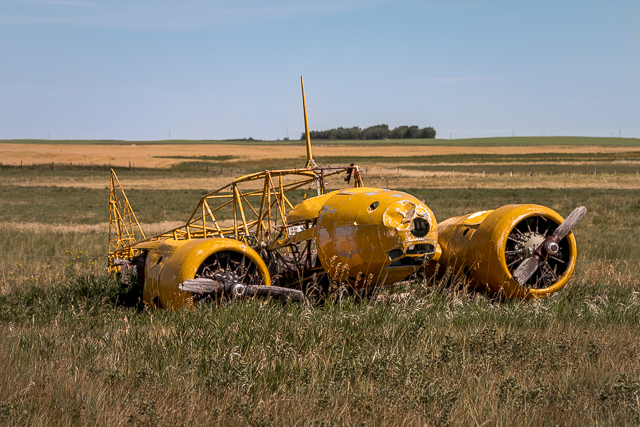
Gravitas, by artist Keith Harder, is located in a farmer’s field just a little south of Calgary (not publicly accessible). It’s bits and pieces of many World War Two Avro Anson aircraft. From the ground it looks like a scrap pile, with no order or layout. Just a jumble of old planes forgotten and left to rot away, some mere skeletons and others more complete, but all seemingly junk. From the air however, the intentions of its creator become clear.
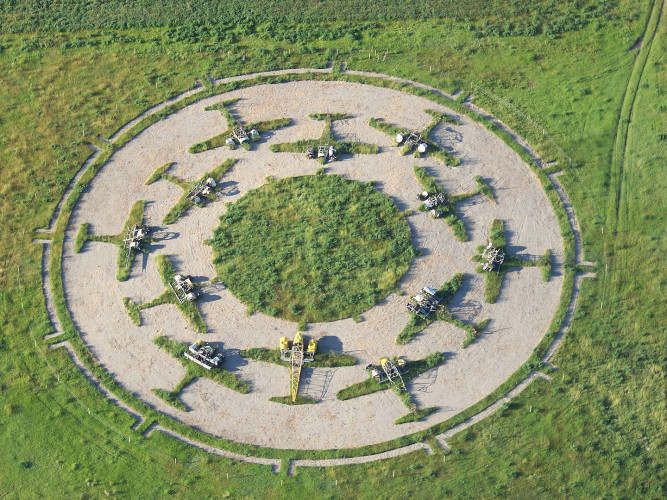
The artist laid out these remains in an exacting, circular fashion and each airframe aligns with a point of the compass. There’s twelve airplanes in total and native grasses form the outline of any missing pieces. To really appreciate this, you should see it from the air, but in a stroke of irony, we’ll have a ground view. It’s a different take, but still mighty impressive from our lowly angle.
Gravitas by Keith Harder: 12 planes in a circle and aligned with the compass. Odd history with Chris Doering & Connie Biggart (BIGDoer/Synd)
Thanks to “Byron Robb” for sponsoring this and many other posts at BIGDoer.com. Be like Byron…
You the viewer are free to interpret the meaning of Gravitas, so make of it what you will. Good art challenges conventions and makes you think as an individual.
Gravitas, made of World War Two era airplanes – the Rockies in back.
They’re war planes but is it about war? They’re old and falling apart, so is the theme decay or even death? Or are we reading too much into it? Why the precise layout? Is it something spiritual…something akin to a Native Medicine Wheel? The answer, we’ll leave up to you.
Scroll down for more photos and to comment.
Ourselves: it’s the Knights of the Round Table and they’re a circle of equals in conference. They’re soldiers awaiting a call to duty and then it’s on to glory.
Gravitas dates to 2009 and is the brainchild of Keith Harder, our host and guide this day. He’s a painter, illustrator, digital imaging creator and sculptor. Produced in cooperation with the Bomber Command Museum of Nanton, the Ansons came from their collection and being surplus to their needs, they were donated to the project.
Picked clean of any needed parts, they helped in the restoration of another Anson, so in that sense they were perfect for this display. Either use them here or let them languish away in the museum’s storage lot, unseen and unneeded. This piece gave them purpose. None are anywhere close to complete airframes, but they’re still recognizable for what they are.
To construct the display, they laid out a large round gravel bed and marked the location of every plane. They craned each aircraft into place and set them down accordingly. It sounds simple, but the artist demanded a great degree of precision and to do it right this last step ate up much time. Keith made sure each aircraft aligned to within a hair’s width of specifications.
The exacting silhouette of complete planes – recall none are anywhere close to that state – were planted with tall grasses and these have grown into the remains. The centre of the circle and a band on the outside edge are also grass, but other areas are bare gravel.
Since the display is close to the road a fair number of people passing by see it (but, reminder it’s on private property). Most, we bet, scratch their heads wondering what it is. Only to view from above is to know it. People in planes can see it and drones can see it. Towering basketball players with stepladders might try, but it’s won’t work. An uber-tall selfie stick is not nearly enough. You need some serious height to take in all that it is.
Most air traffic here is small planes coming and going from a number of rural airports nearby. Traffic to and from Calgary might be too high at this point to really notice the display – is it even on the normal routes? That it’s actually seen by a limited number of eyes makes it no less important. No way and it’s all the more special as a result. An artist like Keith Harder doesn’t do it to put in front of the most eyes possible, but instead eyes that can appreciate it.
From the ground we were able to appreciate the all the components and parts that make it up. Once we got a lay of the land and wandered about, we could image it in its entirety.
The Anson design dates back to the mid-1930s and the aircraft served many roles. It functioned as a light bomber, transport and patrol aircraft, but seemed best suited as an air trainer. Produced by the firm Avro in the UK, demand during World War Two was such Canadian production was established. Many firms were involved, marking parts or complete aircraft, but De Haviland is perhaps the most well known name. Some of the Ansons here have markings from this firm.
In total over eleven thousand Ansons were built across several variants and close to three thousand came from Canada. Production spanned the 1930s-1950s in the UK and 1941 to 1945 in this country. Ones made here are mostly Series (Mark) II and V.
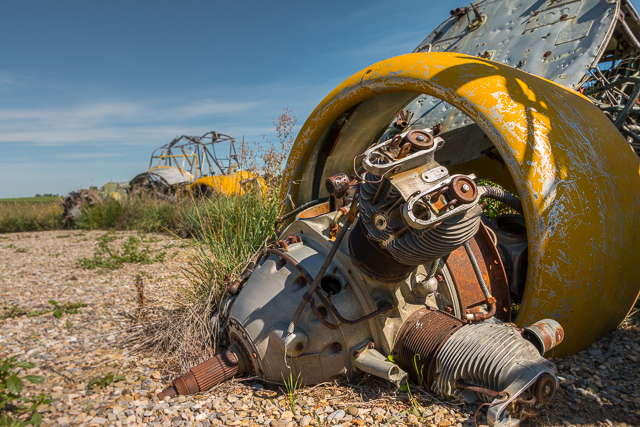
The Mark II Anson has a steel skeleton making up the the body and tail. Some sections were clad in metal and others fabric. Wings were fabric covered wood and a large plywood spar anchors them to the fuselage. A pair of radial engines (from the firm Jacobs on most Canadian Mark II models) provided power to wood propellers (on Canadian models).
The length of the craft is some thirteen metres, the wingspan seventeen metres and they had an operating weight of some thirty four hundred kilos. Cruising speed was two hundred and fifty kilometres per hour.
Mark V aircraft made use of more more wood and that’s due to metal shortages during the war. The planes at Gravitas appears to be made up of the Mark II variety, however.
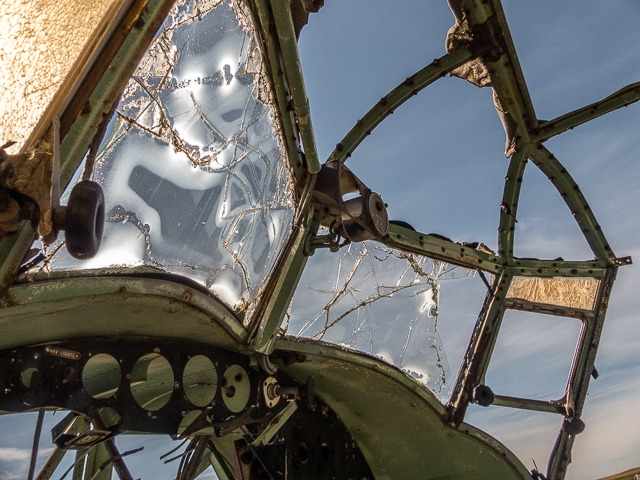
The Anson carried a three or four person crew. Controls were primitive and people comforts unheard of – just look at that seat! Cargo space was minimal. Some Ansons not used as trainers might have a basic armament or were outfitted as a light bomber. They were also used for navigational instruction and other miscellaneous duties, but as trainers they excelled.
The aircraft takes it name from British Admiral George Anson from the 18th century and given success of the design, no doubt he’d be proud.
Most Anson trained pilots went on to fly bombers. Ansons were easy to fly, forgiving, simple to maintain, reliable (hence the Faithful Annie nickname) and this made them a good learning tool. In many ways however, even early into the war, it was an outdated design. Still, it worked well in spite of this and well regarded as a result.
In its own special way it helped the allies win the conflict, even if most of its contribution was behind the scenes in nature. No little boy ever dreamed of being an Anson pilot. Begrudging respect, minimal recognition, but a job well done.
The Anson was the backbone of the British Commonwealth Air Training Plan and pilots destined for the European Theatre were hands-on educated on these planes at any number of airbases scattered all over Southern Alberta. Some of these old airports remain. Over twenty thousand aircrew, from all over the Commonwealth, received their training on Ansons.
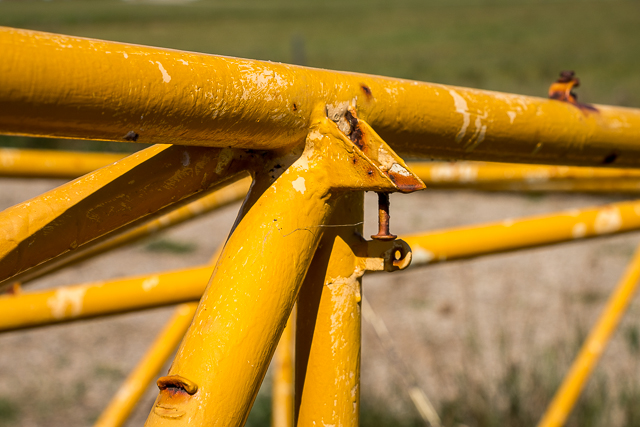
The Gravitas planes still display splotches of British Commonwealth Air Training Plan yellow on many exposed surfaces.
Wandering about the remains, one can’t help think of those brave souls who then went on to fly in the war and didn’t make it back. Or let’s think of those who came back broken or damaged in some way. It’s a sombre connection, but sometimes this life requires a sacrifice.
After the conflict, most Ansons were sold as scrap and many were snapped by farmers who salvaged parts of them for other uses. Ahhh, reinforcing that frugal farmer stereotype. Often any leftovers were then dumped in the back forty, along with old trucks, retired tractors and other metal bits. Junk rarely left the farm. Many old airframes, even if now in parts, survived fairly intact thanks to all this.
Later museums and collectors would acquire many Ansons.
The Bomber Command Museum of Canada in Nanton (somewhat south of Gravitas) dates back to the 1980s and is home to several vintage war planes including an Anson currently undergoing restoration. They have a fair stockpile of parts and parts aircraft in their inventory which to pull from. Some bits may have come from the very planes placed here by Keith Harder, and that’s something cool.
Gravitas: (Oxford Dictionary – Noun) Dignity, seriousness, or solemnity of manner.
Native grasses grow as the outline of missing parts.
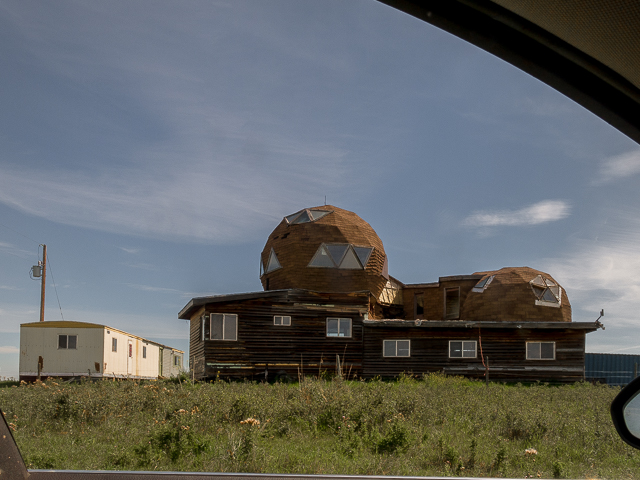
The crazy dome home is on the same property and we got to visit it once some years back. It’s wild. The piece is not online anymore but maybe one day we’ll repost it.
This article is one of those that went corrupt due to that database crash (we talk of it a lot lately) and we reposted it here with a rewrite, but using original photos. The site lost many posts in that fateful event and any worth salvaging (not all are) will get a similar treatment before they’re made public again. They older stuff needed work anyway, and this gave us an excuse to fix them up.
Something to say and no one to say it to? Go here: Contact Us!
Date of adventure: August 2016. Location: south of Calgary (please view from the road). Article references and thanks: Artist Keith Harder, Bomber Command Museum of Canada, Nanton Alberta and the Book Canadian Warplanes by Harold A. Skaarup.
_________________________
BIGDoer.com: Historic Connections & Comparisons – Curious History – Adventure – The Beer Parlour Project 🍺











Comments are (OFF)