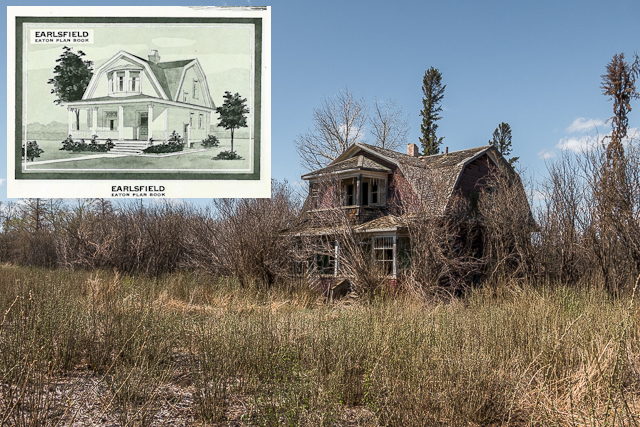
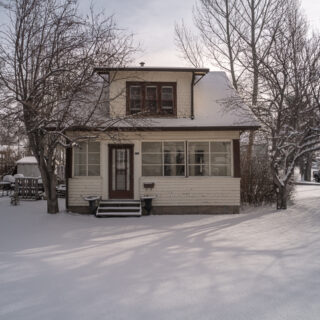
Presenting a Eaton’s Earlsfield Catalogue Home from the 1910s, in a derelict state sadly, and found down a Western Saskatchewan backroad. The mighty T Eaton company dates back to 1869 and were a retail juggernaut that sold just about everything at some point. You name it and for a time this included houses of several models.
These were shipped to you as do-it-yourself kits and even with limited experience a reasonably proficient handyman could put it all together. Or you could hire a local contractor to do it for you. The Earlsfield design was the Eaton Company’s most common and with its distinctive double-gambrel roof, the most recognizable. It’s really pleasing aesthetically.
Eaton’s Earlsfield Catalogue Home: their most popular design. Moving in Chris Doering & Connie Biggart (BIGDoer/Synd)
Thanks to “Anonymous” for sponsoring this and many other posts at BIGDoer.com. Be an angel…
The majority of Eaton’s homes – any model and not just this one – can be found out in rural parts. Still, we know of some in towns and cities. It was just an easy way to become a home owner, especially in areas not yet well developed. Browse the catalogue, pick your design (they had many), add options, and arrange delivery to the nearest railway siding.
Scroll down for photos and to comment.
Eaton’s produced this design from 1912 to 1920, but the Earlsfield name did not come until late in production. Even so, it soon became the blanket name for all of this design, even the earlier built ones. Sort of a retroactive renaming, if you will.
In the past, it was listed as plans #68 or #668 in the catalogue, depending on the year, or in some issues also known as the “Modern Home”. To everyone today, they’re an Earlsfield and always will be.
The Eaton’s company offered homes from 1910 to 1932, but none left a mark like this model.
There were several other players in the catalogue home market in Canada – United Grain Growers and Aladdin come to mind. Eaton’s was by far the largest and most well known. Sears, an American firm, offered kit homes down south, but did not have a Canadian presence at the time. Everyone knows of the firm, so it’s understandable there’s some confusion. If you see a catalogue home in Canada and someone says it’s from Sears, it probably isn’t.
Eaton’s catalogue homes were often given fanciful names in later years, all beginning with an E. There’s an Eastcourt, Eastholm, Eadwin, Earlswood and so on. This replaced that less exciting numbering scheme used early on.
We have a access to a few Eaton’s Home Catalogues and share the following…
In 1913, the cost was $696.50 for the base home. That’s FOB or Freight on Board (or Free on Board) Origin, meaning the consumer paid the cost of shipping.
An Earlsfield in the 1916 plan book cost $887.50 delivered to the nearest railway siding and from there it was up to you to get to the final location. That’s for the lumber and any extras incurred additional shipping costs, but still, it was cheap. Heating and plumbing added an extra $240.
By 1918 the base cost had risen to $1192.73, with heat an additional $155 and plumbing $200 more. Inflation hit Canada as World War One wound down and it’s reflected in the cost of the house.
Once on site, a foundation was needed, but otherwise the kit had everything you needed to finish it to completion. Then all you had to do was move in and put your feet up.
Many rural catalogue houses did not receive wiring for electricity at the start and that would come later. It’s hard to imagine that things we take for granted as every day, were a luxury at one time.
This Earlsfield received some modifications, with an enclosed porch – useful during cold Saskatchewan winters – and an upper deck, also enclosed. It’s not clear if they customized it during construction (not unheard of) or if they added it later during renovations.
The house is sheathed in that fake-brick siding so popular in the 1940s and 1950s period. Insulbrick, as the industry called it, was an inexpensive, and low-maintenance alternative to traditional siding and usually applied over what ever sheathing was already in place.
Insulbrick had some insulating properties and eliminated the need for painting. It’s not the prettiest thing, but it was functional.
For a long, long time this house has been empty. It seems pretty solid, however, and this is a testament to Eaton’s choice of materials and presumably, the care taken in building it. Considering it’s open to the elements, it looked pretty tidy inside too. Some windows, a good sweeping and you could move right in.
Don’t tempt us.
The late Les Henry, a Catalogue Home expert, mentioned knowing of several dozen confirmed Earlsfields out in the wild. We can think of at least a dozen or so that we know of, but we’ve hardly been everywhere and nor have we kept a proper tally. There were some copies made, so not everyone we’ve seen is necessarily an Eaton’s, but probably is.
Of the ones we know of there’s a mix of occupied houses and like this Earlsfield, some that are empty.
In spite of looking far and wide for the total Earlsfield production numbers, we not found anything concrete. Hundreds? Thousands? Somewhere in between? We chatted with Les before his passing and while he didn’t know himself, he was working on an estimate. We never heard what it was, if he got that far.
The comparison image used in this post comes from the 1919 Eaton’s Home Catalogue. It seems they printed these separate from the main catalogue, but we’ve also seen them as an addendum. Eaton’s distributed their catalogues far and wide, and the company proved especially popular on the prairies. While they had outlets in major centres, they’d also ship anywhere and that was the appeal. Not matter how out of the way or remote, it would get to you.
Interestingly, most Eaton’s Catalogue homes were sold in Western Canada and are especially common on the prairies. Ditto for catalogue homes from other firms. The west was going through a growth spurt at the time and housing was in demand, especially in out of the way places.
Time eventually caught up with the Eaton’s firm and they closed in 1999 after 130 years in business. It seems they lost their way in later decades and went from being a budget friendly department store that sold everything, no matter how everyday, to offering higher-end merchandise alone.
Something to say and no one to say it to? Go here: Contact Us!
Date of adventure: 1916 and May 2025. Location: Western Saskatchewan. Article references and thanks: University of Calgary archives, Les Henry and his book Catalogue Houses – Eaton’s & Others and Eaton’s Catalogues at various sources.
_________________________
BIGDoer.com: Historic Connections & Comparisons – Curious History – Adventure – The Beer Parlour Project 🍺



Comments are (OFF)