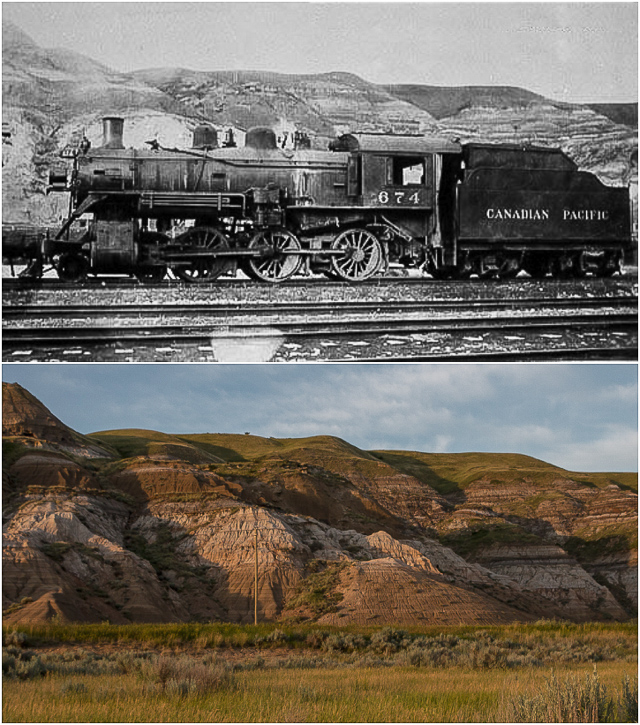
East Coulee Alberta is former coal mining town and the setting for today’s Then and Now post. You won’t see the community though, and instead we’re down at the railyards. Or former railyards in the today sense. In hand is a 1930s view and we’re duplicating the shot. The old image shows a Canadian Pacific Railway locomotive, #674, with the valley wall as a back drop.
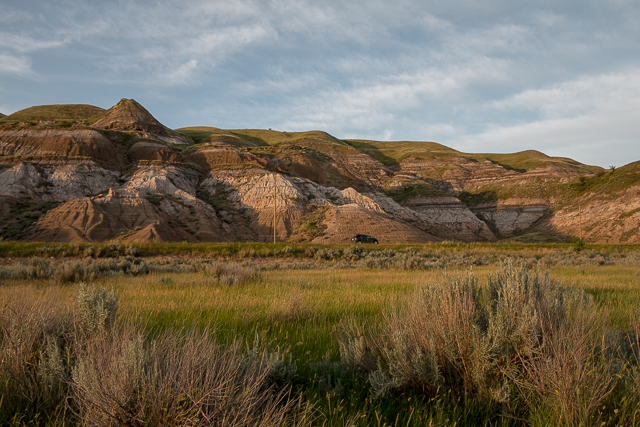
While the trains are long gone and it’s like they never existed here, the background looks the same.
The Then image is thanks to the University of Calgary and they’ve dated it ca1938. It comes from the Ray Matthews collection of train images, which is extensive. There’s thousand of railway shots there (heavy with roster photos) and browsing them is a real treat. We know not who captured this photo, but are thankful we could put it to use in an interesting way.
Canadian Pacific #674 East Coulee Alberta: 1930s and 2025. Across time with Chris Doering & Connie Biggart (BIGDoer/Synd)
Thanks to “Anonymous” for sponsoring this and many other posts at BIGDoer.com. Be an angel…
Not just a collector, Ray Matthew also co-authored a number of books published by the British Railway Modellers of North America. This includes Railways of Calgary and several volumes of Canadian National in the West. We’re so glad his images were saved and donated on his passing.
Scroll down for photos and to comment.
If you have an old photo that might work good as the starting point for a BIGDoer.com Then and Now, please reach out. Broad street scenes and landscapes work well. Railway themed ones like this are welcome too! We’re a bit train crazy and there’s not a twelve step program that can help.
East Coulee was founded in the late 1920s and this corresponded with the opening of several coal mines and the subsequent arrival of the railway. This was a joint Canadian Pacific/Canadian National line with each firm operating it for a portion of the year. There was lots of coal to move (East Coulee alone was home to a half dozen mines at one time) and no space here in the narrow valley for two competing railways.
So they shared trackage, which was not unheard of, but not terribly common either. Usually they harboured a deep, mutual hatred and were at each others throats, but if working together could turn a profit, they might begrudgingly cooperate.
In service of the mines, the railways built a yard on the north side of town. They hauled some grain out of the area too, but it’s coal that filled most trains. Some mines were right beside the yards, on that slope in back in fact, and a few others located across the Red Deer River and accessed via a bridge. That old structure is still there and we may have to write about it again sometime.
From East Coulee coal moved west to Drumheller and from there to many points of the compass. Coal was of the domestic variety, for heating and cooking. Calgary was a big market. Trains could also head east from here on a line serving Eastern Alberta and Western Saskatchewan.
They moved mountains of the stuff and at the peak many trains per day originated in East Coulee. Passengers came and went too. Many locals and through trains made it a busy place. A switch crew kept busy shunting cars at the mines and at times, and old photos shows the yard was sometimes full to bursting. There was a station at the south side of a yard and a small area for locomotive servicing area with turntable, not far away.
Today, it’s all gone.
With the wholesale change over to natural gas, the demand for domestic coal fell off precipitously by the end of the 1950s. Mine after mine closed. Still, two coal companies in the East Coulee area continued on into the 1960s and one, the Atlas Mine went on to be the last one in the entire Red Deer River Valley. It only closed in the late 1970s or early 1980s (data is a bit contradictory).
In later years the railway used the yard mostly for the storage of rail cars awaiting repair or scrapping. They closed the line to the east in the late 1970s, but the line west lasted a few more years. With the coal market in decline the joint operation ended at some point and the line became CP only. The shared track shows up in late 1960s maps and timetables, but by the next decade seems to vanish from the record.
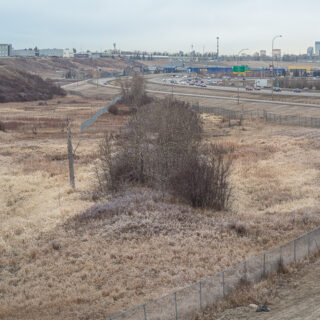
With the rails and infrastructure removed, the property is just a big field-sized plot of empty land and is overgrown. Some sections at the far eastern edge have houses on them now. The current highway runs on the north side and the town of East Coulee is right behind our shooting position.
Canadian Pacific Railway #674, is a D10c class Ten-Wheeler built in 1906 by the Canadian Locomotive Company of Kingston Ontario. Canadian Pacific owned hundreds of similar engines and they proved themselves well suited for lighter duty, yeoman work. They were perfectly at home pulling local freights or passenger trains, branchline runs or doing switching duty.
As jacks of all trades, they found use all across the entire CP system. They proved perfect for all the low density grain branches the railway had out this way and handled rough track well.
The CPR scrapped #674 just as diesels were making inroads. How many miles did it travel from 1905, when built, to 1949, when stricken from the roster? What towns did it see? How often did it pass through East Coulee? We can speculate, but will never know. Here perhaps, it’s just brought in the local run from Calgary, or perhaps just finished switching the many mines in East Coulee.
The locomotive is rather haggard looking and the white-ish stains are from hard prairie water. It’s full of minerals and leaves a distinctive film behind anywhere water leaks or escapes.
The D10c class engines built by the Canadian Locomotive Company comprised fifteen units numbered #670 to #684. CLC built other subclasses, the CPR themselves also did for some, as did the Montreal Locomotives Works and an American builder. Across all subclasses (D10a through D10h) the railway acquired over five hundred in the years 1905 to 1913.
Management, crews and those who maintained the engines all seemed to like them.
“Their success lay in a dependable and uncomplicated design, which incorporated such technical improvements as piston valves and simplified valve gear.” – Canada’s Science & Technology Museum. They have one in their collection and it’s a D10g subclass.
All D10 classes were similar in design and abilities, but with subtle differences. They had six driving wheels and four leading, used to help the the locomotive negotiate curves and for stable tracking. Several of the class are preserved at various museums.
East Coulee is in the scenic Alberta Badlands and a bit east of Drumheller. It’s an area marked by stark landscapes of distinctive alternating bands or layers. These comprise mudstones, sandstones, shales, and of course, coal. Little vegetation grows on the slopes and this leads to erosion. Their shaping is always changing, yet remarkably from this view, it as though they’re static.
Some 80-90 years later and the land in back looks exactly as it did. People come and go and what they create is often here and then gone, yet this scene is timeless.
Something to say and no one to say it to? Go here: Contact Us!
Date of adventure: Ca1930s and June 2025. Location: East Coulee, Alberta. Article references and thanks: UofC Photo Archives, the late Larry Buchan, the book “Constructed in Kingston”, Alberta Energy Regulator and Frank for letting us crash at his place.
_________________________
BIGDoer.com: Historic Connections & Comparisons – Curious History – Adventure – The Beer Parlour Project 🍺


Comments are (OFF)