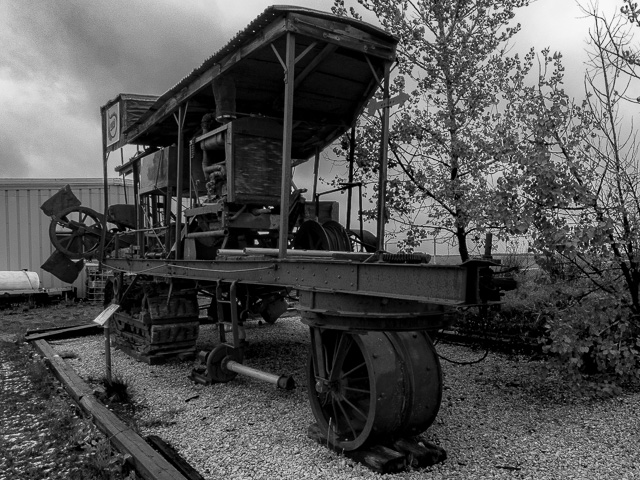
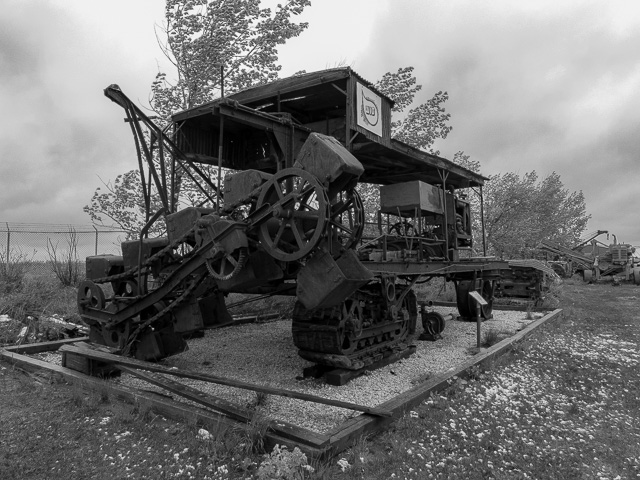
This DNR Excavator is a strange metal leviathan and you can find it at Pioneer Acres in Irricana Alberta. The museum is a great place if you love old machinery and things of that nature. Of all the mechanical wonders in their expansive collection, this strange beast is perhaps the most curious. You got to ask “what in the world does it do?”
On first impressions it may look as though they threw together some random bits with no a clue as to purpose or function. It’s a…I give up…I don’t know. However, it proved to be well designed machine and did its specialized job efficiently. It’s tech for the era, we suppose. There were several DNR Excavators made and they were a success in spite of looking like something from the mind of Rube Goldberg.
DNR Excavator (Ruth Excavator): strange looking but with an important role. With Chris Doering & Connie Biggart (BIGDoer/Synd)
Thanks to “Byron Robb” for sponsoring this and many other posts at BIGDoer.com. Be like Byron…
About a century ago you might find a machine like this hard at work in the dry-belt regions of Alberta constructing or maintaining irrigation ditches. Without, there would be no life giving waters for arid and otherwise unproductive land. Larger canals fed these smaller waterways, which extended out in all directions.
Scroll down for photos and to comment.
DNR Excavators (also spelled D.N.R) date from the late 1910s to early 1920s period and came from a plant in Calgary. We don’t know what the three letters in DNR stand for, but maybe one day we will. They’re initials or an acronym, presumably, but in regards to what or who remains unclear. We found the name of the designer and other higher-ups connected to the project and nothing matches up there.
Using a bucket mechanism, a DNR Excavator could cut a new waterway or clean out one already made. The machine straddled the work area and inched forward while doing its thing. In a continuous motion too. It then dumped spoil to one side and that’s the whole process. Viola! Let the H20 flow!
A similar machine sourced from the US inspired the DNR Excavator. Called a Ruth Dredger, they were made in Los Angeles CA starting about 1908. The Ruth company sent up a single machine to the Calgary area for field testing, but it didn’t work as hoped.
“One of these machines was obtained and tried out during the season of 1918 and proved that it was of the right type but was poorly designed and built, so that it would not stand up under the work. Since this problem at that time was a very pressing one, it was arranged to re-design the Ruth Dredger…The new machine was improved in every detail except the bucket line, which was the patented feature of the (Ruth) machine.” – Transactions of the Engineering Institute of Canada (1924).
The resultant data from the trial helped them design something similar and better. The bucket assembly was the only part deemed satisfactory and carried over to the new design.
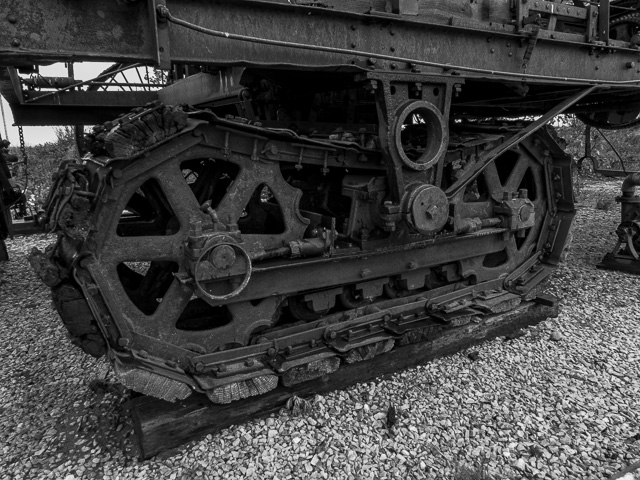
Interestingly enough, Ruth itself later copied some of the features of the DNR Excavator. So, the crawler track for example – Ruth had a big wheel in that spot. This: “The Ruth dredger has since been greatly improved and the new models are in successful use now in the United States.” – Transactions of the Engineering Institute of Canada (1924).
By our tally, there were at least 16 DNR Excavators, but there may have been more. These machines were a success and got the work done more efficiently and with less cost when compared to other methods. Or compared to other machines. Reports suggest the cost benefits were significant and for one season (early 1920s?) in one irrigation district, they saved about $50k. We’re talking over three quarters of million today and that’s noteworthy.
“There are now six excavators in use on the Western section, nine on the Eastern section and one on the Lethbridge section (ed: with perhaps a couple in reserve). The credit for the design of the D.N.R. Excavator, rests chiefly with Ben D Fessenden, assistant canal superintendent in charge of mechanical equipment on the Western section and E Dutcher, mechanical engineer for the Riverside Iron Works.” – Transactions of the Engineering Institute of Canada (1924).
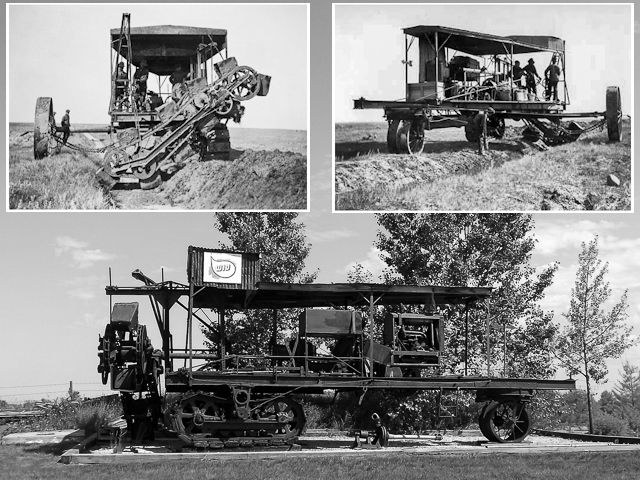
The irrigation districts seemed to identify each DNR Excavator with a unique number, but we were unable to find which in the group this was. Old photos show several different units and we wonder if this example might be any of those seen. In comparing it to old those photos it appears the Pioneer Acres DNR Excavator is complete. We wonder how far gone it is and if when first parked (whenever that was) if it was still functional.
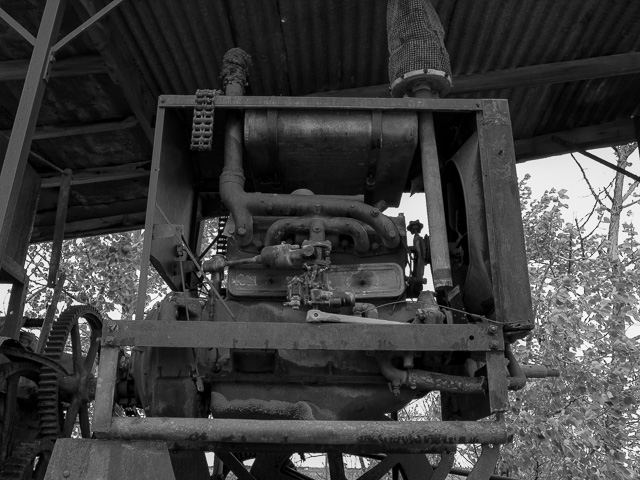
A gas engine provided power for motion and drove the bucket assembly. You could adjust the angle of the latter, depending on the depth of the trench required. Rudimentary steering was via a single front drum-shaped wheel with a wind-vane looking arrow connected to the system. This confirmed at a glance the direction of travel. Since the machine moved slow and with the front wheel mostly hidden from view, it might not be so obvious where you’re heading.
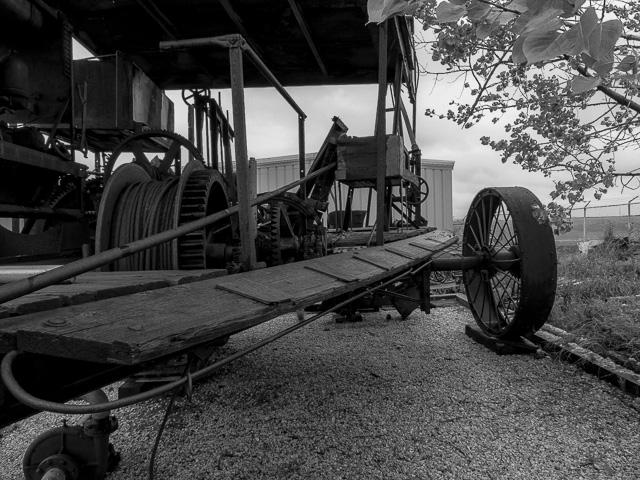
The large wheel opposite the crawler was unpowered and using a telescoping axle, it extended out as needed to span the trench or ditch. The machine has a cable winch and this might come in handy in many ways. Like getting unstuck.
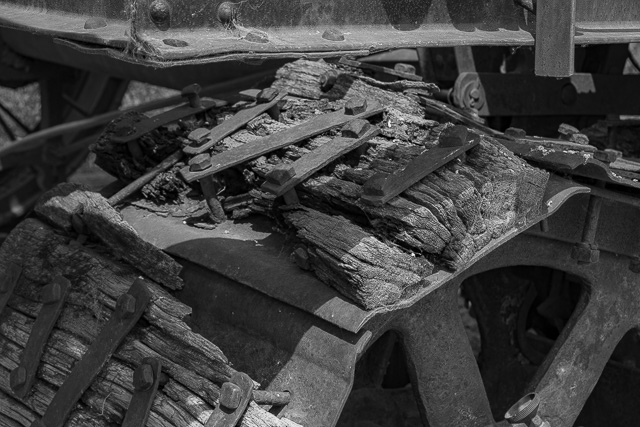
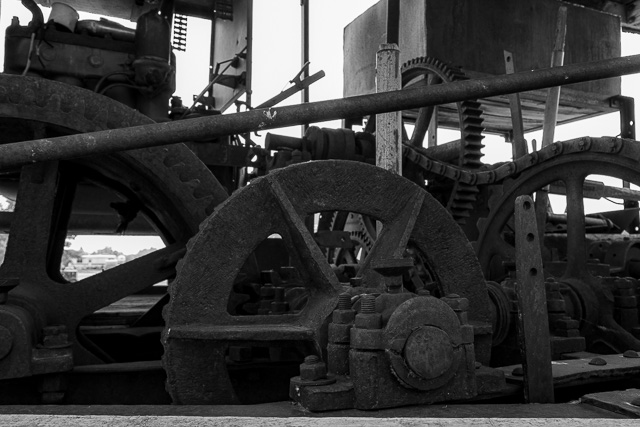
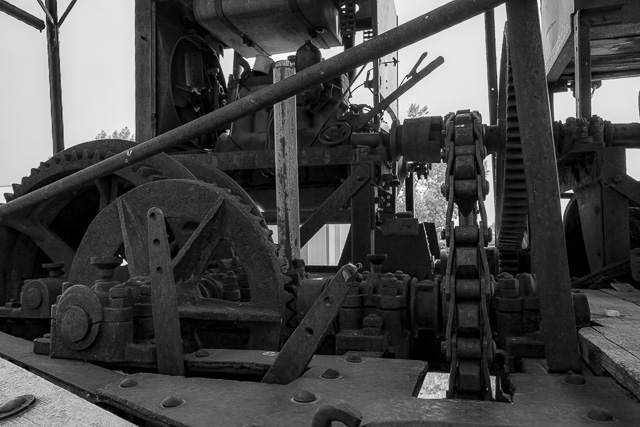
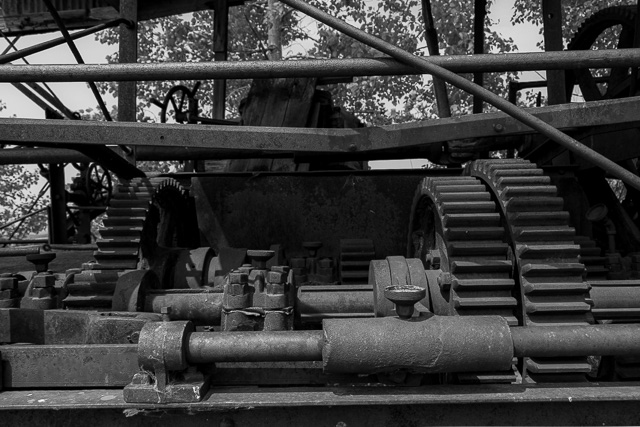
Overall the shape of the machine is that of wedge, with an offset tricycle type setup and with most of the working parts on one side. The machine is a great mass of steel beams, rivets, gears, cams and levers.
DNR Excavators worked at a snails pace and said to average a speed of five feet per minute with 13 to 15 buckets dumped in that time. The noise must have been deafening and the ride bone-jarring. And those many moving gears and chains, all open and exposed…so much danger. What’s the lost finger count?
Calgary’s Riverside Iron Works built the DNR Excavators at their compact plant in Bridgeland across from downtown. Interestingly, those old buildings still exist and are now home to some retail shops. The Riverside firm was the go-to in the city when one needed something formed or fabricated of metal. They seemingly could make anything of steel or iron. Among the things they built includes mine equipment, farm machinery, and structural assemblies.
Riverside moved to the Ramsay neighbourhood in the late 1920s and soon after was folded into the huge conglomerate Dominion Bridge. That former factory still exists too and for one, there’s a company there that makes film sets. We’ve been inside and it’s something to behold!
Is a DNR a Ruth? At least some documents/photographs seem suggest it. The former is clearly inspired by the latter and even uses some Ruth designed parts. Both serve a very similar purpose and even look somewhat alike. Still, think of them as two separate types, but with a family connection.
The DNR Excavators originally worked for irrigation districts owned and operated by the Canadian Pacific Railway. These include the Western District near Calgary, the Eastern District near Brooks and the Lethbridge District near the city of the same name.
Later the CPR would divest itself of these subsidiaries and ever since each has operated independently. Then, as today, water brought in from elsewhere is the only reason there’s large scale farming in those regions. The reservoirs, canals and ditches that make up the respective networks were and still are a life line.
Pioneer Acres received this DNR Excavator as a donation in the early 2000s. It’s the last to exist…we think. In years past, it was on display at the Western Irrigation District offices in Strathmore, but removed due to a widening of the highway. Given that location, we assume it was always a WID machine, but who knows for sure.
Old photos found during research show several DNR Excavators (usually listed as a Ruth Dredgers) at work. In two views of the same machine dated 1919 (Eastern Irrigation District – seen in this post – via UofC Archives), it shows they used crew of three and with one on the ground presumably orchestrating it all. No doubt it was a hard, back breaking job and to operate it required an attentive crew.
Modern day trenchers might look different, but they are not all that far removed from the DNR Excavator in spirit.
Pioneer Acres Museum is a heavenly place if you like old machinery, trucks or farm equipment and is definitely worth a visit. They have enough stuff to keep one busy over several visits. You might even find us there at random times wandering about. In the past, we’ve volunteered building exhibits or shooting promotional images and would love to do it again.
Now scroll down to the photos and marvel at this odd machine. The images are from a few years back and from several visits, but the DNR Excavator looks pretty much the same today as it did then. This piece is repost from one first published in 2016, but rewritten for better clarity.
There is so little information on the DNR machine, that nothing really comes up in a search but this post.
They’re saying…
“Chris and Connie have a unique way of documenting the places they visit, not copying the style or technique of others, but making it their own.” Alex Craig, Filmmaker.
Something to say and no one to say it to? Go here: Contact Us!
Date of adventure: July 2012, May 2016 and July 2023. Location: Pioneer Acres Museum, Irricana Alberta. Article references and thanks: Pioneer Acres Museum, book – Transactions of the Engineering Institute of Canada (1924) and the University of Calgary archives.
_________________________
BIGDoer.com: Historic Connections & Comparisons – Curious History – Adventure – The Beer Parlour Project 🍺


Comments are (OFF)