Flashback to September 2017 and we’re hanging out in Western Saskatchewan. In the town of Unity to be exact and with a vintage postcard in hand. Our mission is to shoot a BIGDoer.com comparison and we’re certain that old image will be fodder for an interesting small-town adventure. It always seems to work out this way.
Our target is the Unity Cenotaph and its surroundings. We’ll seek it out and do our best to duplicate the original in angle and composition, for posting here and then we chat about it here. There’s two locations to visit in this case – the memorial has moved as we found out – plus we later discovered there’s a third connection we can share.
Unity Saskatchewan Cenotaph: two for the price of one! A slice of Canadiana with Chris Doering & Connie Biggart (BIGDoer/Synd)
Thanks to “Craig Pearn” for sponsoring this and many other posts at BIGDoer.com. Be like Craig…
This day finds us down by the train tracks where the Cenotaph was back then. We’ll see what we can find that connects the two eras and then we’ll go where the memorial is today, in a park a few blocks away, and do the same. That should keep us busy and entertained for a while.
Scroll down for photos and to comment.
Then, there’s another connection with the town’s train station, which as it turns out we’ve photographed before. It’s not in Unity anymore and instead is some distance away in Alberta. It didn’t click right away, but now we can throw it in the mix too.
Unity dates to about 1909 and sprung to life with the coming of the Grand Trunk Pacific Railway. It quickly grew to be an important hub for the area and today is home to about twenty five hundred people. The main industries here are grain – lots of farms in the area – and natural resources are big too.
The railway, now Canadian National, is a busy stretch of track. Passenger trains go through a few times a week and will stop in Unity on request. Not that it happens very often, but the option is there.
The then photo is a postcard, in the public domain, and was sourced in-house. We don’t know the photographer nor the exact date of the shot. The image shows Unity’s Cenotaph sitting in a small park like setting in front of the train station. In behind, grain elevators are seen, along with boxcars on the elevator siding. It’s a pretty typical small prairie town scene from long ago.
Today, the scene is different, although it still sort of feels the same.
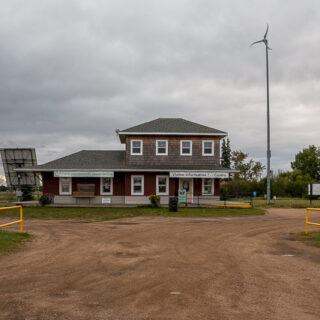
The circa 1909 train station is gone from town, but not demolished. It was saved and today resides out near Calgary, at Aspen Crossing in Mossleigh. They have a campground and do train tours there too. Our photo is from some years ago, when it was still in storage. The building now functions as the registration centre for campers and houses a camp convenience store.
The building to the right of the station in the old photo is a freight shed and today it’s at a museum in Saskatoon. I see a Then and Now in the making there, should find ourselves out that way.
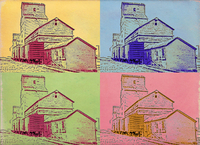
The wood grain elevators are no more and that’s a sad thing we suppose. These buildings, marked for National Grain and Federal Grain, date back to the the 1910s and were gone by the 1980s. They had a multitude of owners over the years beside those two companies. Both National and Federal were decent sized players in the Canadian Grain Industry. Each had elevators in numerous small prairie towns, and both firms vanished in the 1970s.
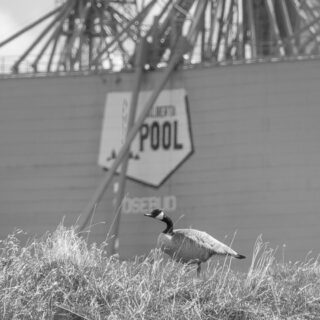
Today, a late-1980s concrete “grain terminal” stands in their place and stored tank cars filled the old elevator siding on our visit. In the past there were other wood elevators in Unity, but they were off frame in the old photo. There’s other grain terminals just outside town and we had to stop by to check it out too.
There’s only one element connecting the two eras here and that’s the remains of that low concrete wall.
The Cenotaph resides in a park today and a short walk from where it originally stood. Otherwise it seems little changed. It’s a pastoral setting with lots of shady trees and grassy areas. It’s a nice, peaceful place for reflection and thought.
Connie notes the last name Biggart on the side of the memorial. That’s hers as well and it’s not the most common, but she’s certain there’s no connection.
The date of the then image is unknown, but there are some clues to help narrow it down. We know the National Grain Company didn’t acquire the one elevator until 1940 so minimally it’s from that date.
Something tell us it’s from later, however – so after World War Two. Based on a quick and dirty tally, not a lot of postcards were produced during the war. But, it also appears the Cenotaph is in its current form in that old photo, with names from the World War Two period appearing like they do today.
When the Cenotaph was first erected or moved is not known, but research suggests the 1920s and the 1970s to 1980s period, respectively. There’s not much info out there on this subject, so we’re basing these dates on photo evidence. The memorial stands out and by going through dated images where it appears, we can make an educated guess. But there’s big gaps in this methodology.
Our search for a local history book came up empty and it’s possible it holds the answers.
Interestingly, the memorial names locals that fought in World War Two, but not the war before. It just makes mention of them collectively, without saying who.
A list of names…
“In honour of all who died for the cause of freedom in the Great War 1938-1945.”
1st Side: Ballantyne, WB, Bell AF, Blanchard LW, Carson F, Dulham AM, File EK, Fleming D, Fogg ED, Hayard DI, Knoke J, Knowles D, McCallum W, McKinnon RG, Mullins FE, Orr RS, Postlethewaite GE, Reid WV, Taylor HB, Williams R, and Werry WE.
2nd Side: Anderson TR, Austin AW, Aldridge C, Akrigg J, Biggart A, Britter R, Bunce J, Byrnes I, Craig E, Cooley W, Delamere G, Delemere J, Davis E, Davies Rev WH, Jacobs A, Jarvis HJ, Johnson C, Knowles A, Knowles PP, and Keist A.
3rd Side: Laker F, Leckie N, MacDonald J, McCubbing W, McCullough G, Moorlend L, Pettypiece T, Rodgers P, Robertson J, Rose C, Skerry WH, Stewart A, Wilson T, Williams WJ, Williams WT, and Wickham AL.
4th Side: “In Honour of All who served for the cause of Freedom in the Great War 1914-1919. Somme, Ypres Mons, Arras Vimy and Passchendaele. Erected by the Citizens of Unity and District.”
It seems to us that folks on the prairies were quick to enlist during times of conflict and did so in proportionally higher numbers than elsewhere. Go to any small town in the grain belt and the Cenotaphs always seem larger than expected. Perhaps it’s just a passing observation or reflects on the get-things-done attitude of prairie folk.
A Cenotaph is a monument erected to those who served their country and there’s examples in most towns and cities. A moment of silence in remembrance of those who fought for our freedoms is a great way to show respect when visiting one.
Old photos used in these comparison posts are usually sourced in-house, but some are thanks to readers. If you have an old image from a family collection (for example – but they must be your copyright) you think would make a good starting point for a BIGDoer.com Then and Now, by all means send it our way. We’re always looking for fresh challenges and an excuse to visit new places!
This is an older piece brought back and it received a full rewrite, but uses the original images. It was a rather harsh day for photography, but when on the road, you sometimes have to take what you can get. If we ever find ourselves in Unity ands with a little time to spare, you know we’ll reshoot it.
Something to say and no one to say it to? Go here: Contact Us!
Date: Ca1940s and September, 2017. Location: Unity, SK. Article references and thanks: Town of Unity, Saskatchewan Wheat Pool Records and Canada Census.
_________________________
BIGDoer.com: Historic Connections & Comparisons – Curious History – Adventure – The Beer Parlour Project 🍺




Comments are (OFF)