The historic road/rail bridge in East Coulee Alberta has stood since the 1930s and spans the muddy Red Deer River. Last used about four decades ago, it was built by the railway to access nearby coal mines and later it carried vehicular traffic as well. This wood structure is an abandoned state now and deteriorates a little more with each passing year.
This scenic valley here is a deep cut on the Alberta plains and space is at a premium. At one time East Coulee was home to about a dozens coal mines and one of the largest, and the very last to operate in the entire region, was the Atlas. It’s directly across the river from town and is now an historic site you can visit.
Historic Road/Rail Bridge East Coulee AB: disused for decades. Pop history with Chris Doering & Connie Biggart (BIGDoer/Synd)
Thanks to “Craig Pearn” for sponsoring this and many other posts at BIGDoer.com. Be like Craig…
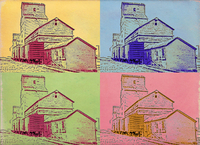
This bridge allowed the railway to access to the Atlas, a grain elevator, plus two other coal mines nearby. These were the Western Monarch, to the left (east) of the Atlas and the Murray, to the right or west.
Scroll down for photos and to comment.
Built in 1936, the bridge is built of wood and not of steel as one would expect for the time. This was likely an economic measure, but it’s not really stated in any records we found. Some of the beams are simply HUGE.
The structure is in the Howe Truss pattern and not the similar Pratt design, so common in railway use. The two look much alike with similar horizontal, vertical and sloped elements. In the Howe style the main diagonals slant outwards, towards the ends, vs inwards for the Pratt. That’s what separates them visually, but there’s other things in play, forces of tension and compression. In that they differ.
For wood construction, the Howe seems the favoured choice of the two by how these forces are applied. Huge bolts and many interconnecting steel rods hold together the jumble of timbers.
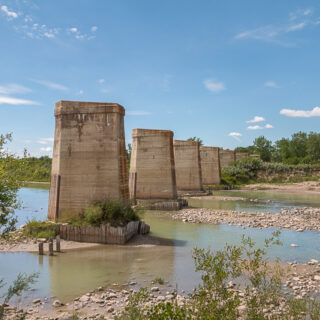
When built, the support piers were of wood (pilings surrounded by earth and rubble, with a wood-plank casing). Sone later replacement piers were of concrete.
The bridge received damage in the spring of 1948 due to ice build up, and the overzealous use of explosives used to clear the mess. Ooops! Photos from the time show one span leaning at a precarious angle. We suspect those concrete piers we spoke of in the previous paragraph were from the subsequent repair work. Research suggests ice flows damaged the structure in other years, but specific details are sketchy and perhaps did so in not such a dramatic fashion.
At some point, (1950s) the bridge had decking installed that allowed auto traffic to cross the structure. Prior to this only trains crossed, plus pedestrians accommodated on a side walkway, now mostly collapsed. Autos used a ferry before this.
The last trains to use the East Coulee bridge were sometime in the late 1970s or early 1980s period. Records show conflicting dates – an all too common occurrence when compiling histories. It appears autos continued to use it until that point and did so for a few years after at least. A replacement road bridge was later put in a short distance downstream and the wood bridge fell into disuse. To prevent cars from crossing, road barriers were put in at each end.
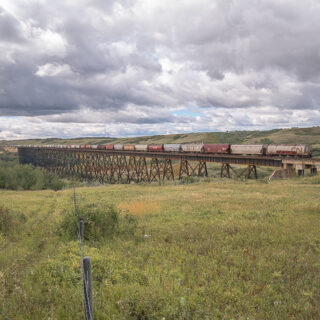
The small shack at the north end of the structure was for a traffic controller and their job was to stop autos from crossing when a train was due. Back when coal was still king, it was a busy spur line, so this was necessary.
The railway line in the area was joint operated by Canadian National and Canadian Pacific, but along this stretch (Rosedale to a point east of East Coulee) it was owned by the latter. The two firms were bitter enemies typically, but due to space constraints in the valley were forced to cooperated under a shared trackage agreement.
This arrangement meant you could see trains from either company on the line, but not necessarily at the same time. We understand one railway worked the local customers for half of the year and other for the rest. This arrangement may have ended at some point as traffic fell off.
In other parts of the valley towards Drumheller the roles were reversed and CN owned the track (Rosedale to Drumheller).
The line though East Coulee dates from the latter half of the 1920s and when the last mine shut down (the Atlas), it was pulled up soon after. Coal traffic from the East Coulee mines (and many others in the Red Deer River valley) could travel east or west to points in Southern or Central Alberta and into Saskatchewan. The coal mined here was a low value commodity and it usually didn’t travel too far.
East Coulee/Red Deer River Valley coal was of the domestic variety. It’s well suited for home heating and cooking, but that market started drying up as natural gas made serious inroads starting in the 1950s.
At the peak of coal usage many trains came and went from East Coulee each day. By the end of service, output was mostly seasonal and sometimes many weeks passed without anything being shipped out.
Before the Atlas and the other mines on this side of the valley opened up, others used to operate on the town or north side of the river.
Fast forward to today and bridge structure shows the ravages of time and the elements. The deck is rotting away, but the main beams appear solid enough. A top cross brace has detached and some settling has caused the spans to shift somewhat.
Our photos are from earlier visits when you could still venture out on the bridge without issue. It was wide open back then and we used the older photos because of this. We’ve visited the structure countless times since, but the view is no longer as good as it was. Now fencing at each end protects the structure from entry and sort make it hard to take photos like we’ve shared here.
Various agencies recognize the the structure as historically significant and for its endangered status. It’s unique in that it’s of wood, was dual road/rail, was an essential link for local coal mines and that it uses a rare for today truss design.
Everyone hopes it can be saved and perhaps incorporated into the Atlas Mine museum located nearby. The old Atlas workings are within sight of the bridge and are a bit to the east. Imagine a pathway, across the structure, connecting the Atlas with the nearby East Coulee School Museum in town. It would be quite an attraction and a great heritage walk. Doing this of course requires money, lots of it, and securing that is a tall, tall order. Things seem to stall when the subject of funding comes up.
For now there’s sort of a holding pattern. Progress for these things always moves slowly anyway, but at least people and various groups are talking about it. Dialog, hopefully, may yet turn to action.
In the meantime, the railway still holds title on the East Coulee bridge. That’s the CPR, although some sources suggest the ownership may be more complicated (and it very well could be). After all these years they have not fully let go of the property, even though the tracks have been gone for an eternity, and it sure seems odd.
The railway industry in Canada, based on our own personal observations, seems disinterested in matters of an historical nature such as this and lacks sentiment. They are a business after all and with that in mind, getting any kind of help from them kind of seems unlikely.
East Coulee dates to the late 1920s and was founded concurrent with the railway arriving and the beginning of coal mining here. A coal town for much of its history, today it’s home to around a hundred and fifty people. Compare that to the peak in the early days, when a couple thousand resided in town.
East Coulee is little changed in many ways and is sort of a time capsule from a bygone era. It’s now part of the extended municipality of Drumheller but still goes by the original name. If you stroll around town, be sure and take in the many old miner’s cottages.
Joining us this trip is our good friend and noted film photographer Robert Pohl. He shoots some vintage gear and we hang out a lot. Making this a theme, we felt it a good idea to bring our vintage Minolta along and shoot a few frames of film ourselves. For old times sake.
The comparison images used in this post are thanks to the late Larry Buchan, who worked for the Canadian Pacific Railway. We were friends and miss our little chit-chats. His knowledge of the railway proved boundless and his memory recall was amazing.
Larry’s images date to the 1970s (pretty sure the latter half) and were captured while he was working in the area. Taking photographs while an employee of the railway is presently a no-no, but back then it seemed to be accepted.
Something to say and no one to say it to? Go here: Contact Us!
Date of adventure: 1992, 2012, 2015 and 2017. Location: East Coulee, Alberta. Article references and thanks: University of Calgary photo archives, Geoffrey Lester, Various CPR Employee Timetables, Author and Cartographer, Canadian Trackside Guides, Alberta Energy Regulator, Book: Hills of Home – Drumheller Valley and Larry Buchan.
_________________________
BIGDoer.com: Historic Connections & Comparisons – Curious History – Adventure – The Beer Parlour Project 🍺


Comments are (OFF)