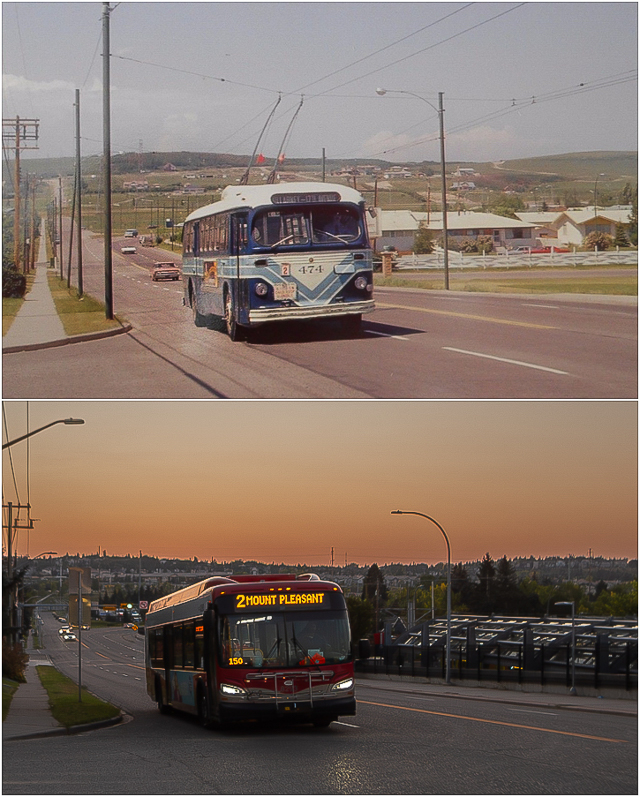
We’re standing on the same spot as some unknown photographer did fifty one years ago and making a BIGDoer.com Then & Now Historic Comparison. What a thrill! In this ongoing series, we take an old image, track down the location and then do our best to duplicate it as closely as possible. Today’s theme is Calgary Transit, the date of Then photo is 1974 and we’re along Route #2 on 17th Ave SW.
The original is scan was sent to us by a reader and collector of worldwide transit images. They hail from France…thanks Stéphane! We’re not completely sure how they made the connection to us, but we’re glad they did. This person mentioned purchasing it on eBay, as a slide, and knows nothing about it other than the date (it’s written on the photo) and that it’s from Calgary (ditto). The photographer of the original? That person is a mystery, but who ever you are, we thank you.
Calgary Transit Route #2 17th Ave SW – 51 Years Apart. A BIGDoer.com Then & Now with Chris Doering & Connie Biggart (BIGDoer/Synd)
Thanks to “Someone” for helping out and sponsoring this post. Be a Someone…
Do you have an old photo like this, transit related, or just showing an old street scene, that you think would make a good comparison post? If so, we’d love to hear from you! Actual photos are welcome – we’ll return them – or scans can be used as well. It’s all good.
Scroll down for photos and to comment.
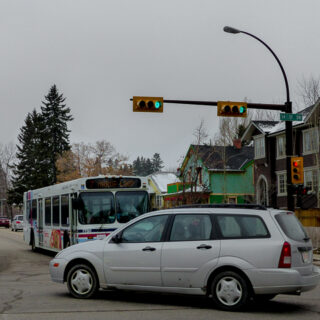
The original shows a Calgary Transit Electric Trolleybus heading east and in our now image we captured a CTS diesel powered bus on the same heading. Both are on route #2, known then and today as the Mount Pleasant – Killarney 17th Ave SW run. At this point, both buses have just left the Glenside Drive Loop, a couple blocks there in the back, and are downtown bound. Back there down the hill is where they turn around after reaching the end of the run.
This section of the route runs east/west and was extended out this way in the early 1960s. It passes through the neighbourhood of Killarney on the trip (among others) and keeps to 17th Ave almost all the way to and from downtown.
Once in city centre, the route turns north and runs along 4th Street NW (mostly). It passes through the community of Mount Pleasant and others. This second leg runs on north/south heading. Buses then spin around and do it all again in the opposite direction. Other than some extensions on the north end of the Mount Pleasant section, and some minor changes downtown, the bus from the 1970s and the ones today follow remarkably the same route.
When south and westbound the destination sign normally reads Killarney 17th Ave SW. When east and northbound it should say Mount Pleasant. In the old photo the bus is heading east and it appears the driver did not change the sign. It says 17th Ave SW, but should red Mount Pleasant (as the bus in the now photo does).
The location of these two photos is close to BIGDoer HQ (look for us under the big flashing neon sign) and it’s the closest Then and Now to home we’ve done. A short walk on a fine evening, and it was in the can. Had to do it twice though to get it right.
The trolleybus (or trolley coach) seen in that old photo, #474, is a Canadian Car and Foundry model T44. How it works: T for Trolley and 44 is the number of seats. This example dates to 1950 and was one of seventy seven on the roster, built in the years 1947-1950. Similar in appearance were eight slightly larger T48 models, from 1950-1953, plus a small number of US built trolley buses bought second hand. These last ones differed in appearance and didn’t seem to get out much.
This trolleybus carried a special experimental paint scheme and it’s believed to be the only one on the entire roster done this way. Trolley or diesel, we’ve never seen another so painted. Photo evidence suggests this was added a few years before.
There are flags on the trolley pole retriever wires and that’s something we’ve never seen before. To make them more visible…maybe?
Canadian Car and Foundry was a builder of railway cars, and for a time aircraft. They also produced transit and highway buses from 1945 to 1962 (trolleybuses 1946-1954). Many of their designs were built under license from the Brill division of American Car and Foundry in the USA. The two firms had similar sounding names but were otherwise not related.
CC&F buses came from their factory in Fort William (now Thunder Bay) Ontario. It still exists today and makes rail transit vehicles and passenger cars. Industry giant Alstom is the current owner and before them it was another big player, Bombardier Transportation.
Trolleybuses were fashionable for a short time just after World War Two in North America, but quickly fell from favour. They did and still do offer some specific advantages, if applied correctly. In the end, they lost out to diesels, which are more flexible and didn’t require any form of expensive overhead infrastructure. Even so, many trolleybus networks lasted for a long time in Canada, with many still functioning well into the 1970s.
In Europe and elsewhere (former Soviet countries especially), they were and are more common.
By the time of the “Then” image, the trolleybus network in Calgary was near done. It would close down early in 1975 and soon after was nothing more than a memory. Route #2, along with #3 Centre Street/Elbow Drive and #7 South Calgary were the last electric trolleybus lines in Calgary.
This trolleybus, along with many others, were later sold to Vancouver Transit. Mostly they were used as part’s buses to help keep the rest of that fleet running.
Vancouver BC has the only trolleybus system left in Canada today and it managed to survive when others didn’t. It’s quite modern now and well utilized. At the peak there were about a dozen cities that operated trolleybuses in Canada and now it’s only that one. Edmonton operated them until 2009 and they were the second last holdout.
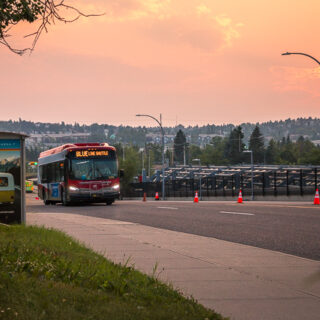
The bus in the Now image, Calgary Transit #8293, is a New Flyer model XD40 diesel bus built in Winnipeg Manitoba. X = Xcelsior line, D = diesel, 40 = forty feet long. It’s from 2013 and one of a hundred and forty nine such buses on the CTS roster (built 2013 & 2014).
New Flyer, founded in the 1930s, is one of the big producers of transit buses in North America and has supplied many coaches to Calgary Transit. This, however, was the last order CTS made with the firm (as of the writing of this piece) and they currently favour another maker (NovaBus).
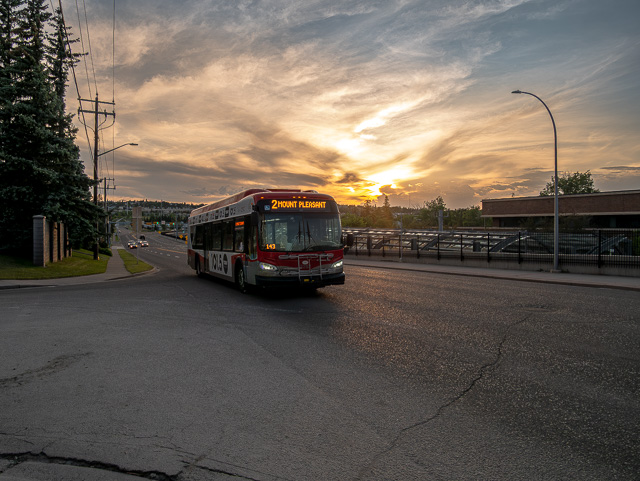
On an earlier attempt at this Then and Now, in June, coincidentally bus #8292 (so one number lower) was the one we captured. None of the photos from that first outing lined up well enough to be used, but the skies were nicer. You can’t have everything. This highlights one aspect we rarely speak of, that it usually takes many tries to get it where we’re happy. In case of this one, we photographed five buses over two visits, before we got the one used here.
Notice all the changes since the first photo capture, but still the neighbourhood mostly feels the same. 17th Ave is much as it was and that’s amazing in this dynamic, always-changing city. There’s still lots of single family dwellings in the neighbourhood, as there was back then. As the city grows upwards and outwards, it may not stay this way forever. In fact, just to the left of our position, a big condo unit is going up.
That arched structure to the right, in the Now photo, is a Light Rail Transit (C-Train) station. Back when CTS trolleybus #474 was captured, a Drive-in Movie Theatre stood here on 17th Ave SW, and they were in business from the early 1950s until the late 1970s. The screen burned down in spectacular fashion one Halloween night, a suspicious fire we might add, and just as the place was winding down operations forever.
The theatre was at the fringes of town when built, but was soon encroached upon by residential housing. You have to wonder how the neighbours coped with all that noise, lights and traffic? Townhouses and a commercial block now occupy the former drive-in lands, but there are plans to level the latter (the former Alberta Motor Association building) and built some high density mixed commercial/residential properties there. Time will tell.
The entrance to the Drive-in is to the left of the bus and just in front of that white fence.
One of the houses seen in the background of the old photo, behind the white fence, is still there, but now obscured by trees.
That’s Signal Hill in back. In 1974 it was all pastures and fields, with a few scattered houses, but today it’s a dense residential neighbourhood. Notice how much greenery there is now verses the 1970s. This was the western edge of town, but now it’s kilometres more in that direction. In 1974 the city had population of about 430 000 and today it’s over a million more.
So ends another BIGDoer.com Then & Now and it’s time to stroll home. What a nice evening…both times…thanks all.
Something to say and no one to say it to? Go here: Contact Us!
Date of adventure: 1974, June 2025 and with an update in September 2025 (from a piece published in 2015) Location: 17th Ave SW, Calgary, Alberta. Article references and thanks: The Canadian Public Transit Discussion Board & Wiki, Calgary Transit, Stéphane who shared the original image, and the City of Calgary.
_________________________
Offbeat Adventures – Lost & Forgotten Places – A Slice of History – Connections & Comparisons – The Beer Parlour Project🍺
Comments are (OFF)