On a dreary fall day we’re wandering cart tracks and cow paths searching for ghosts of the Suffield Subdivision. We’re speaking of a former Canadian Pacific Railway line that once ran from nowhere in particular and on to someplace you never heard of. It travelled through remote and lonely country in the dry belt region of Eastern Alberta.
They must have been crazy to build it and the section we explored never achieved the on-line traffic levels anticipated. Still, it lasted some sixty years.
The folks behind it (the railway, promoters and the government) had high hopes for the area, but it wouldn’t happen without irrigation. Construction on canals started concurrently, but the whole scheme soon collapsed and they remained unfinished. By the time this happened, the railway was already committed.
Ghosts of the Suffield Subdivision: a middle-of-nowhere adventure. Obscure history with Chris Doering & Connie Biggart (BIGDoer/Synd)
Thanks to “Dale” for sponsoring this and many other posts at BIGDoer.com. Be like Dale…
Remains of the canals are still there, and a silent reminder of dashed dreams. They’re not the subject of this post, but we suspect they will be some day. Today, we’re railway archeologists and looking for anything connected with this forgotten line.
Scroll down for photos and to comment.
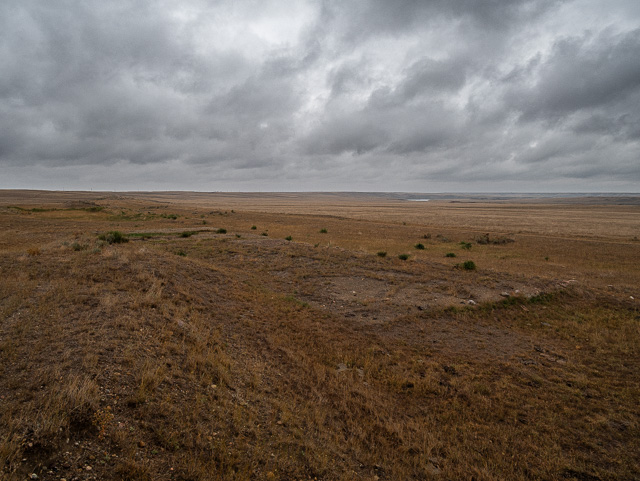
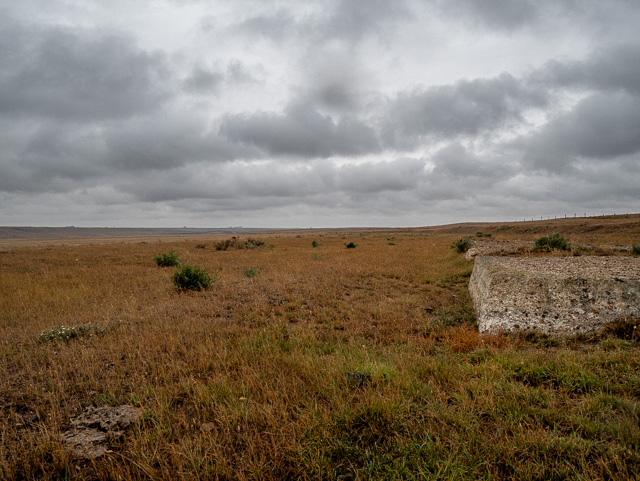
We found it in a little place marked Cecil on maps (visited with permission of the landowner). All that’s left is a railway roadbed, the foundation of a grain elevator and an old loading dock. This paucity of remains means a good imagination is needed to picture what was here, but set your mind free and it all comes together. The obscure places like this fascinate and thrill us the most.
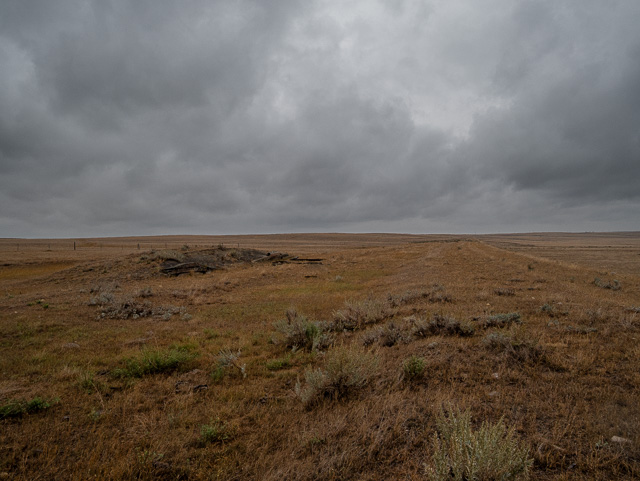
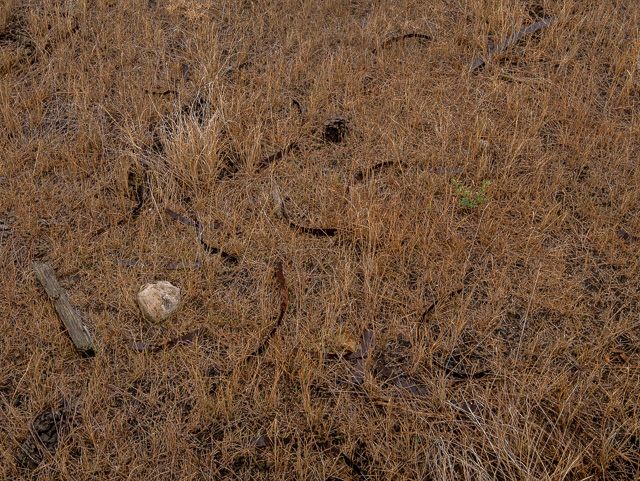
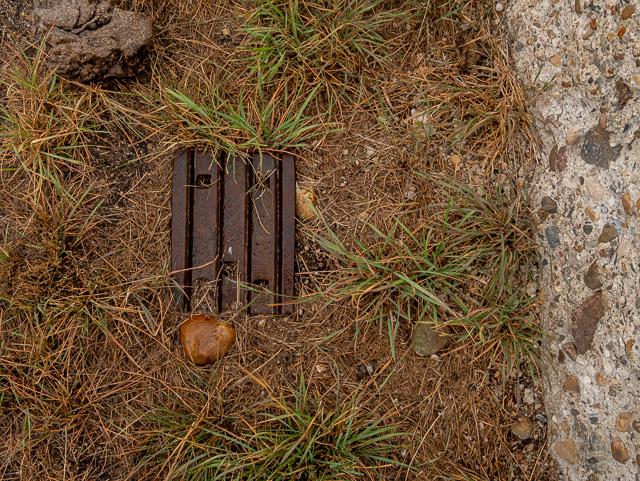
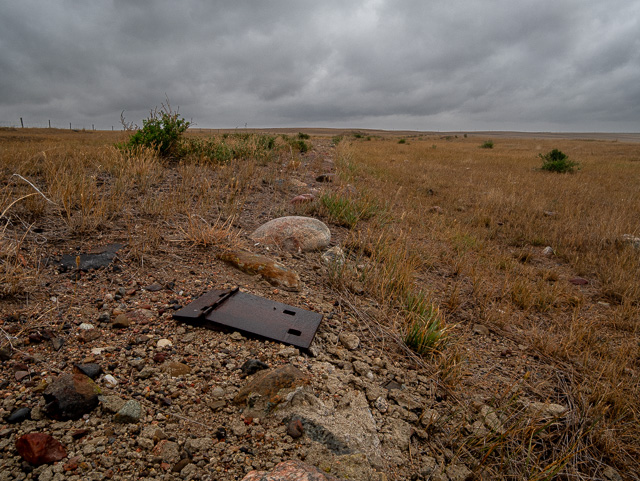
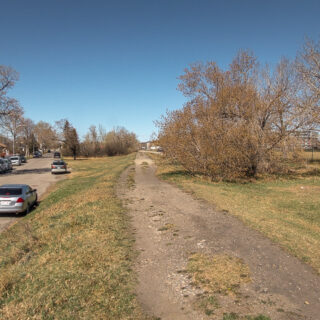
That berm marks the main track and it continues on in both directions to the horizon. You can see depressions marking the location of ties. Underfoot, there’s the odd spike or tie-plate left behind after they salvaged the track.
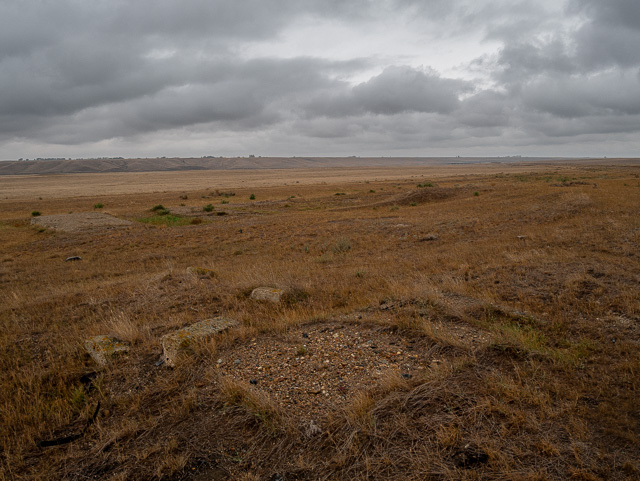
Another berm was for a siding and on one end there’s remains a dock for handling bulky shipments moving by railway. Like lumber or farm equipment.
On the opposite end of that same track is the remains of a single grain elevator. There’s cement pads indicating its location, that of an annex and a third for the drive house/office. Metal banding is scattered about this area.
This my friends is Cecil and you just got the full tour. We searched around the area for signs of a train station – a depression or pad – but found nothing. It was likely a flag stop and the station not much more than a shed in form, but still we thought something might remain. But, no.
The search broadened to look for signs of a house or houses nearby, but outside accommodations for the elevator operator (possibly) we don’t think there was ever anything else here. There’s no records in that regard, but still we looked and came up empty. Nothing as far as you can see and it’s just natural, undisturbed prairie.
Think of Cecil, not as a town, but as a siding along the Suffield Subdivision. It was marked on maps and still is, but then as today, there’s not much reason to note it. Still, the railway served an important function as a lifeline for people from the area, what few there were. It’s a little backwater, but an outside connection to the world was no less important than if it were a big city.
The CPR’s Suffield Subdivision branch left the mainline outside Suffield Alberta and continued on to Cecil and beyond. It then proceeded to Vauxhaull and on to Lomond, where it connected with the Lomond Subdivision. That track continued west on to a point south of Calgary where it joined with a major north/south line.
Along the easterly half of the Suffield line, it passed through arid country with no irrigation and farming was minimal. Further west there were canals or natural rainfall was sufficient to support crops. But here, that’s a hard no and as such the western section was always busier.
Otherwise it was a typical prairie grain branch, albeit longer than most and comprising two subdivisions. Track arrived in the Cecil area during 1913, but not completed to the most westerly point of the combined subdivisions until 1930.
The only shipper of note along this stretch was the Cecil grain elevator and that’s hardly enough to support its continued use (also a local coal mine, but it didn’t last long). There was also some through traffic in earlier days, but still, it was not an ideal situation. When the Cecil elevator burned down in 1973 the trains stopped running along altogether. However, the railway listed it as in-use up for a few more years, even if there was nothing moving.
“No traffic has been generated on the Hays to Suffield portion for some years.” – A Canadian Government report on grain dependant prairie branchlines from the mid-1970s. It goes on to say that authorization to remove unproductive sections of the line (and you needed a nod from the feds at the time) would occur in 1977.
Regulatory approval didn’t come easy back then and in the meantime, a railway was forced to bear the cost of the disused line. The commission was hard to convince and acted at glacial pace. Soon after they got the okay, the railway removed the rails and ties.
On the other end at the Lomond Subdivision and on westerly sections of the Suffield Subdivision, traffic was sufficient enough to keep it in use into about 2000.
Ogilvie Flour Mills built the Cecil elevator in 1940 and it was pretty typical of the era in size (35K bushels). This firm had a modest network of grain elevators across the province. The company made flour, cereals and other ground-grain products.
In 1960 Ogilvie sold their elevator network to the Alberta Wheat Pool. At some point early on in the Pool era – we think – an annex was added the west side of the building to increase its capacity. Records are scarce (and we’ve never seen a photo), but in a report from the 1960s it seems the listed capacity of the building had increased.
The Cecil elevator burned down in July 1973. By this point, it was the only grain elevator (and presumably the only shipper of any kind) along the most easterly 55km section of the line.
The next nearest grain elevators along the Suffield line were in Grantham, some 30km away by rail and after 1954, in Hays, some 15km away by rail. Hays marks the most easterly section of irrigation and from there to Suffield, it was dry as a bone.
Looking at Cecil one can’t help feel a little sadness at what was. There was never much here to begin with, but it was the centre of the world for some folks and now it’s all gone. That it was a gloomy, wet and cold day, in this remote and lonely corner of the province, did not help lift spirits. At the same time, however, it allowed a deeper connection to the things and people that came before.
Both of us stand there silent and look around, as we often do. We try to imagine it in the past but who known how right we are. Even though drenched and shivering, we take the time to reflect on this little unknown place. The cold makes it seem like hours, but it’s over in a minute or two.
We’ve known many out-of-the-way places, but none as lonely as this. Not a one, and we’re no strangers to remote backroads.
Something to say and no one to say it to? Go here: Contact Us!
Date of adventure: October, 2023. Article references and thanks: The late Jim Pearson’s Vanishing Sentinels Book Volume 1, the University of Calgary archives, Canadian Government Grain Commission reports (1970s) and the book “From Sod to Silver”.
_________________________
Offbeat Adventures – Lost & Forgotten Places – A Slice of History – Connections & Comparisons – The Beer Parlour Project🍺
Comments are (OFF)