The town of East Coulee is in the Alberta Badlands and split by the slow flowing Red Deer River. Space is at a premium in this valley and if you visit, you’ll see this first hand. Homes and businesses, the highway and in years past, the railway, were all located on the north side. On the south bank there were several coal mines and a grain elevator. It’s this industrial side of town we’ll be looking at in this BIGDoer.com Then and Now.
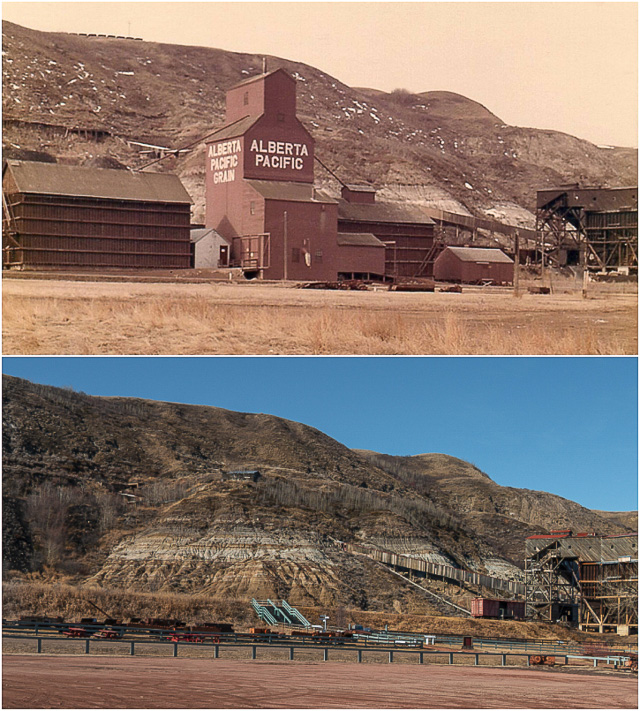
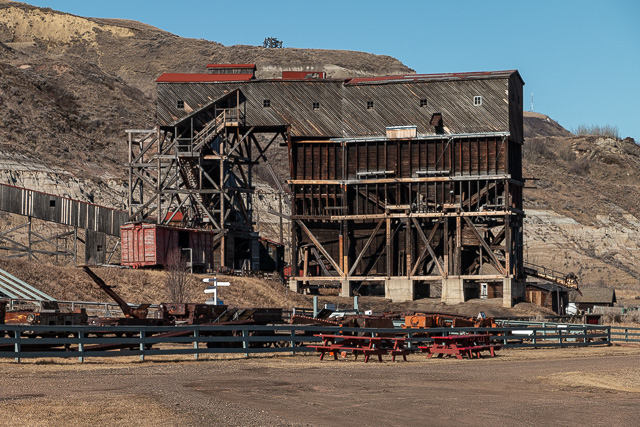
There’s change, as you’d expect and some of it is dramatic, yet there’s a certain timelessness about the place. It’s as though the clock has stood still. Connecting both eras is the mighty Atlas Coal Mine. It was a working mine back then, but now an historic site. It’s the last of its kind and you can pay them a visit. The Atlas tipple appears much the same today as it did in the old photo.
Atlas Mine East Coulee AB 40+ Years Apart. History and fun with Chris Doering & Connie Biggart (BIGDoer/Synd)
Thanks to “Byron Robb” for sponsoring this and many other posts at BIGDoer.com. Be like Byron…
The Then photo is thanks to a reader, Doris Blair, who captured it on film long ago. We appreciate her allowing us to use it and love the shot. It’s from the 1970s, but the exact date is unknown and ours is from 2017. If you have an old photo showing a scene something like this, begging for the BIGDoer.com Then and Now treatment, we’d love to hear from you. We’re always looking for new and exciting ways to compare locations across time.
Scroll down for photos and to comment.
The Alberta Pacific Grain Elevator is most prominent in the old photo. It dates to the late 1930s and this was when a railway spur was extended here across the river to serve the coal mines. The building replaced an earlier elevator on the East Coulee town side and it was a forced move due to the railway expanding its yard there.
The Alberta Pacific firm had a good sized network of grain elevators across the province. The company amalgamated with parent Federal Grain in the late 1960s. A few years later the Alberta Wheat Pool acquired Federal’s assets in this province.
The elevator was in use up until the late 1970s and torn down a couple years later. Never repainted, it wore AP colours and logos right to the very end.
Flanking the elevator are two annexes and these were generally later additions used to increase capacity. Most elevators at some point had one or more of these built.
The elevator office is that small silver shed jammed between the main structure and an annex. Usually, they sat out front, but space was at a premium here to they tucked it away as you see. The other shed to the right might be a fertilizer storage building. Elevator firms often had sideline businesses.
There would be a rail siding on the opposite side of the building for the loading of grain cars.
Today, there’s no sign the elevator was ever here.
To the right is the Atlas Mine and dates to the late 1930s. There was an earlier Atlas Mine across the river opposite the East Coulee townsite and it closed when this one opened.
Once one of dozens and dozens of major coal mines in the Red Deer River Valley, it was the very last by this point. The mine, as did all those in the region, produced domestic heating coal (used in home furnaces and stoves) and were underground operations.
The market for domestic coal trailed off in the 1960s and dried up almost completely a decade or so later. This was thanks to the wholesale change over to natural gas. Due to lessening demand the Atlas only operated sporadically in later years. Production ended completely in the late 1970s or early 1980s – lots of contradictory dates were found during research.
In the past they mined the slope in back but at this late time, the coal came from some distance away up a side valley. A small railway brought it down and you can see a string of coal cars at the top of the hill in the old picture (left). There was a dumper up there.
The Atlas offered mine tours to visitors in off season back then.
That large building is the tipple where they cleaned the coal, sorted it by size and usage, and then shipped it off. The could load trains or trucks.
Photo evidence shows they mostly loaded boxcars here. These were filled by a special movable conveyor and typically emptied by hand at the destination. What a hard and messy job! Most heating coal, at the end, went to rural places, where natural gas had not yet made inroads.
The angled structure heading into the hillside lead to the original main entry and later where the conveyor brought in coal from the car dump on the hillside above.
The Atlas became a designated historic site in the late 1980s and opened to the public some years later. It’s a fine representation of what coal mining in the valley was about. It maintains a lot of historic integrity and is little changed from when built. In terms of production the Atlas Mine was not the largest in the area, but certainly one of the top few.
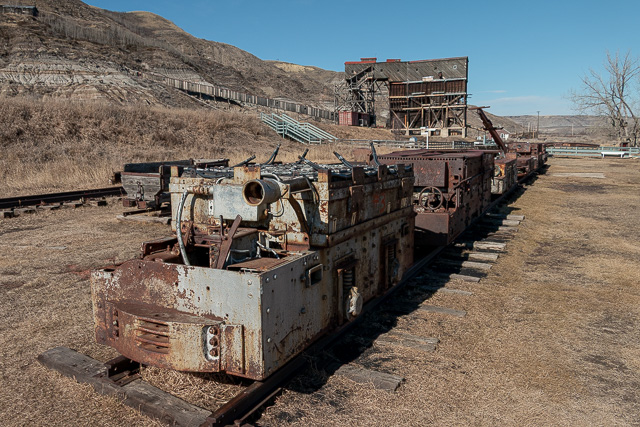
Scattered about the grounds today, including where the grain elevator once stood, are various pieces of underground coal mining equipment. Some are from this mine and some from others that once operated in the valley.
There were once other coal mines right in this area. Seen above the Atlas Tipple, bottom picture, is a tramway tower connected to the Murray Mine. You have to look hard to see it, but it’s there. This operation lasted from the late 1930s to the late 1950s. The tower supported a cable and bucket system that transported waste material for dumping in a side-coulee. There’s a few odds and ends connected to that mine still on site, but nothing substantial.
To the left of the elevator and off scene was the Western Monarch Mine which operated from the 1940s-1960s. They trucked in coal to the loading spur here, from their mine a short distance away. There’s really nothing left from this operation.
Take the Atlas, add the Murray and Monarch, toss in the grain elevator, plus the tracks needed to serve them all, and this side of East Coulee was a crowded place. There were even some company houses on these flats. Today, with the only the Atlas remaining, it’s far less congested. Imagine the noise and dust in the old days.
Not seen, but just right off frame, is a wood bridge used by the railway to access the mines and the grain elevator from the East Coulee town side. It also carried road traffic and we’re going to reposted about it sometime down the road. We know it well and first visited it over thirty years ago. The bridge has been unused since the ’80s and is in rough shape.
In the 1940s, at the peak, trains would service the mines here several times per day and the elevator typically a few times per week. By the 1970s it was all on an as-needed basis.
We were unable to line up the two shots exactly, as we usually strive to do. The height of the land at the shooting position has changed a bit over time. In 2017, it’s a graded parking lot, but back then appears as a small grassy knoll a bit higher in elevation. The Red Deer River is a short distance behind this shooting position.
Thanks for taking the time to read this piece, for your interactions on our social media page, and to those of you who donate to this site. It’s a costly one to run and that help is appreciated. Look for the donate buttons if you want to take part.
Something to say and no one to say it to? Go here: Contact Us!
Date of adventure: The 1970s and March, 2017. Location: East Coulee, Alberta. Article references and thanks: Book – Hills of Home – Drumheller Valley, Atlas Coal Mine National Historic Site, the late Jim Pearson’s Vanishing Sentinels Books Volume 1, Alberta Energy Regulator and Doris Blair for the fantastic Then photo.
_________________________
Offbeat Adventures – Lost & Forgotten Places – A Slice of History – Connections & Comparisons – The Beer Parlour Project🍺

Comments are (OFF)